€12.4 million in additional revenue through A/B testing!

Watch for free now
New Study: How AI Search is Changing SEO Visibility in E-Commerce
Read now


"How much does conversion optimization cost?" is one of the first questions asked before a shop hires an agency. The honest answer is: it depends on a few clearly definable factors. Anyone who gives you a flat rate without looking at your starting position is just guessing.
The price is only half the story anyway. Conversion optimization is an investment that should pay for itself through additional revenue. The crucial question, therefore, is not what CRO costs, but what it delivers.
This article provides transparency on the cost side: common pricing models, the factors that drive costs, and the ROI logic behind it. By the end, you will be able to estimate the scale for your own shop.
1. How much conversion optimization costs: the honest answer
2. Common pricing models
3. What costs depend on
4. The more important question: What does it deliver?
5. How to estimate it for your shop
6. FAQ
There is no fixed price for conversion optimization, and for good reason. The effort required for a small shop with low traffic is different from that of a large retailer that is continuously testing across multiple countries. Reputable providers therefore calculate based on your specific situation, not a price list.
Instead of a single number, you need two things to evaluate costs: an understanding of the pricing models and the factors that determine the effort involved. You will get both in the next two sections.

Takeaways
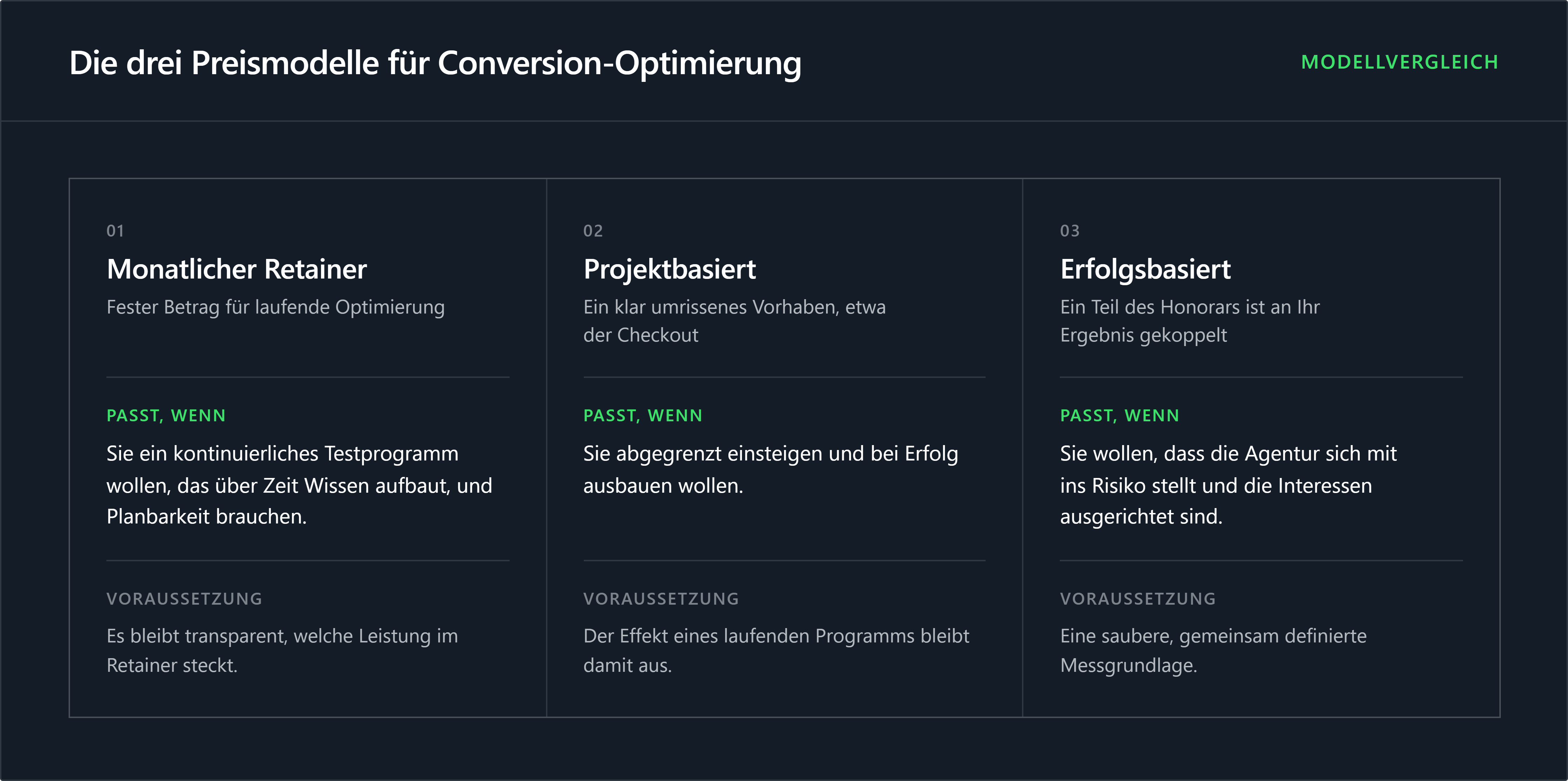
Three models are common in the market, and they differ primarily in who bears the risk.
With a monthly retainer you pay a fixed amount for ongoing optimization. The advantage is predictability and a continuous testing program that builds knowledge over time. It is important that it remains transparent what services are included in the retainer.
The project-based model covers a clearly defined initiative, such as optimizing the checkout process. This is suitable for a limited initial engagement, but it does not provide the impact of an ongoing program.
With the performance-based model the agency ties a portion of its fee to your results. This aligns interests and serves as a strong signal of trust, as the agency shares in the risk. A prerequisite is a clean, mutually defined measurement baseline.
Key takeaways
Four factors determine the effort most significantly. The first is your size: More traffic and revenue mean more and faster tests, but also a greater lever that justifies the investment. The second is the test frequency and program scope: A single test costs less than an ongoing program, but also delivers less sustainable value.
The third factor is the technical complexity of your shop, meaning how difficult it is to implement and evaluate tests. The fourth is the question of internal vs. externalIf you optimize in-house, you pay for staff and tools instead of an agency—a comparison we explore in more detail in our article on the agency-versus-in-house decision.
Key takeaways
Costs alone tell you little unless you weigh them against the returns. Conversion optimization pays off when the additional revenue generated by a higher conversion rate exceeds the investment. Because this effect is lasting rather than one-off, its value grows over time.
The size of the potential leverage depends on your baseline. We use data in our article on conversion rate benchmarks to show the scale of uplift a systematic testing program can achieve. Context makes the potential tangible: since roughly three-quarters of top-tier shops don't test at all, most retailers are leaving significant revenue on the table between the visit and the purchase.
Key takeaways
Statt einer Pauschalzahl hilft Ihnen eine Größenordnung, die zu Ihrem Shop passt. Unser CRO-Potenzial-Rechner überschlägt, wie viel Umsatz bei Ihrer aktuellen Conversion zwischen Besuch und Kauf liegen bleibt. Das ist die Zahl, gegen die sich jede Investition rechnet.
Im Erstgespräch ordnen wir Ihre Ausgangslage ein und nennen Ihnen einen konkreten Rahmen, der zu Ihrem Fall passt. Lassen Sie sich jetzt von unseren Experten beraten. Wenn Sie wissen wollen, was CRO bei Ihrem Traffic-Volumen konkret kostet, schauen wir uns das in einem kostenlosen Erstgespräch direkt an Ihren Zahlen an.
Is there a flat rate for conversion optimization? No. The effort depends too much on shop size, traffic, test frequency, and scope. A reputable provider will calculate based on your specific situation rather than presenting a price list.
Which pricing model is best? That depends on your situation. A retainer suits ongoing optimization, a project-based approach works for a defined starting point, and a performance-based model aligns interests. In any case, the transparency behind it is what matters most.
At what point does conversion optimization pay off? As soon as the expected additional revenue exceeds the investment. This is usually a question of having enough monthly traffic and conversions to ensure tests are statistically significant.
Is CRO affordable for smaller shops? Yes and no. You can start small with a project-based model, such as optimizing a single critical step like the checkout, and scale up once you see results. However, an extensive testing program requires at least 1,000 monthly conversions per device to produce test results quickly.
.png)

About one in four shoppers abandons their cart due to mandatory account creation. Here is how a guest checkout removes the barrier without losing customer accounts.

Most purchases are abandoned on smartphones. Discover where mobile checkouts fail and the levers you can use to boost your mobile conversion.

Around 7 out of 10 shopping carts are abandoned. Here are the known causes and the levers you can use to specifically lower your abandonment rate.

Build SEO in-house or outsource to an agency? Five questions to help you make an honest make-or-buy decision.

Not every CRO agency tests systematically. These 7 criteria will help you identify reliable providers before you allocate your budget.


.png)