€12.4 million in additional revenue through A/B testing!

Watch for free now
New Study: How AI Search is Changing SEO Visibility in E-Commerce
Read now


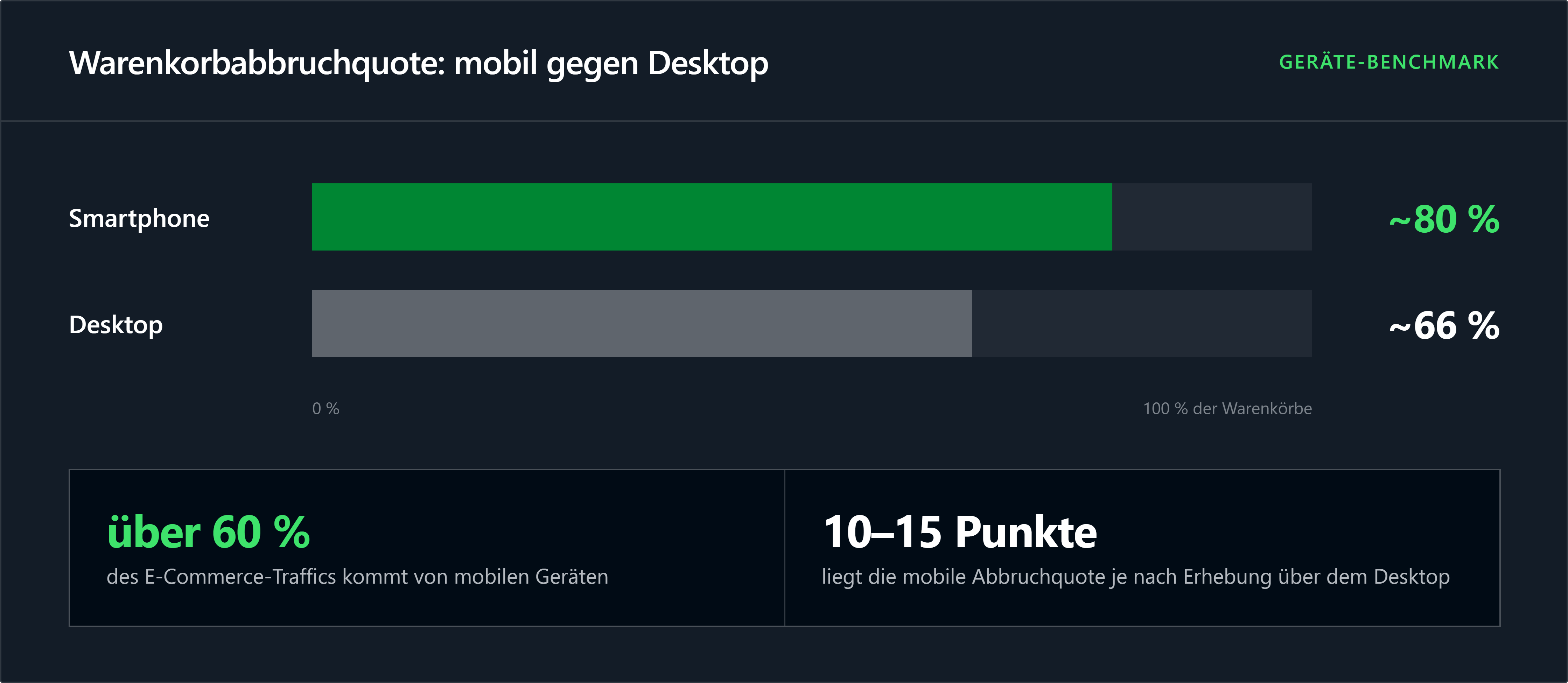
Most people shop on their smartphones today, or at least try to. Over 60 percent of e-commerce traffic now comes from mobile devices. Yet, this is precisely where most purchases are abandoned: the mobile cart abandonment rate is around 80 percent, compared to about 66 percent on desktop (Dynamic Yield).
This is neither a coincidence nor a minor issue. Because the mobile channel accounts for the majority of traffic, it increasingly determines your overall conversion. A mobile checkout is not just a shrunken-down desktop checkout; it is a discipline of its own with unique hurdles. This article shows why mobile purchases fail and which levers you can use to counteract this.
1. Why mobile checkout determines your revenue
2. Where mobile checkouts fail
3. The most effective levers for mobile checkout
4. From gut feeling to testing
5. Your next step
6. FAQ
Mobile is now the primary channel in e-commerce, not just an add-on. Over 60 percent of visits come from smartphones, and even more for many shops. At the same time, a significantly smaller percentage of users complete their purchase on mobile compared to desktop. Depending on the study, the mobile abandonment rate is about 10 to 15 percentage points higher.
Combined, these two effects mean that the majority of your visitors are encountering the weakest version of your checkout. By making the mobile purchase process seamless, you optimize the channel that the majority of your customers use. This is why it pays to treat mobile checkout as a separate entity rather than just letting it run alongside your desktop version.
Key takeaways
Mobile hurdles differ from those on desktop, and almost all of them relate to the user experience on a small screen. The biggest friction point is the effort required to type: long forms that are quickly filled out on a desktop become a test of patience on a smartphone keyboard. Small touch targets exacerbate this, as fields and buttons are often too small for a thumb.
Then there is the payment process. Without express or digital wallet options, users have to laboriously type in their card and address details. Another factor is load time: mobile connections are slower, and every additional second of load time noticeably increases the likelihood of abandonment (Google/Deloitte). Finally, mobile users are often on the go and distracted, meaning any unnecessary hurdle leads to abandonment much faster.

Key takeaways
These levers target the points where friction occurs. The single most powerful lever is Express or wallet payment: Apple Pay, Google Pay, or PayPal replace the need to type in card and address details with just a few taps. For many shops, this is the fastest way to lower mobile abandonment rates.
Additionally, you can reduce the effort required for typing by using autofill and minimal fields: Only ask for what is necessary and use address auto-completion. A thumb-friendly layout with large touch targets, a single-column design, and easily accessible buttons makes navigation effortless. Because every second counts, speed is also essential; a fast mobile checkout keeps users in the flow. For returning customers, saved data further accelerates the purchase process.
Takeaways
Only testing will reveal which of these levers works best for your customers, and this should be done separately for mobile and desktop. A wallet button that reduces abandonment on mobile may have little effect on desktop. If you lump both devices together, you will overlook the differences that define the mobile channel.
However, testing is rarely done in the market. Around 73 percent of top online shops in Germany do not use an A/B testing tool. Those who systematically test their mobile levers instead of relying on gut feeling gain a competitive edge. At LEAP, this experience is backed by over 4,000 A/B tests conducted. We show the scale of uplift that systematic testing can achieve in our article on the conversion rate benchmark.
Key Takeaways
If you want to start somewhere, begin with payments: an express or wallet option is often the quickest win on mobile. For a compact introduction with concrete tests, check out our guide "7 Tests for More E-Commerce Profit".
The reasons for abandonment across all devices are covered in our article on shopping cart abandoners.
What is the mobile cart abandonment rate? It is around 80 percent, compared to about 66 percent on desktop (Dynamic Yield). The exact figures vary depending on the study, but mobile is consistently 10 to 15 percentage points higher than desktop.
Why do mobile shoppers abandon more often? Primarily due to the user experience on a small device: lots of typing, small touch targets, slower loading times, and more frequent distractions while on the go. A lack of express payment options exacerbates this.
What is the biggest lever in the mobile checkout? Usually express or wallet payments. Apple Pay, Google Pay, or PayPal replace tedious data entry with just a few taps and often provide the most significant reduction in abandonment.
Should I optimize mobile and desktop separately? Yes. The barriers are different, and a lever that works on mobile might do nothing on desktop. Separate analysis and separate testing show what actually helps where.
.png)


About one in four shoppers abandons their cart due to mandatory account creation. Here is how a guest checkout removes the barrier without losing customer accounts.

Around 7 out of 10 shopping carts are abandoned. Here are the known causes and the levers you can use to specifically lower your abandonment rate.

The cost of conversion optimization depends on a few key factors. Learn about pricing models, cost drivers, and why ROI is the more important figure.

Not every CRO agency tests systematically. These 7 criteria will help you identify reliable providers before you allocate your budget.

Around 73% of top online shops in Germany do not use an A/B testing tool. Here is why this is the biggest untapped lever in e-commerce and what systematic testing actually achieves.


.png)