€12.4 million in additional revenue through A/B testing!

Watch for free now
New Study: How AI Search is Changing SEO Visibility in E-Commerce
Read now


In e-commerce, few channels impact profitability as significantly as SEO. For the largest German online shops, organic search accounts for a median of 42.5 percent of total traffic (LEAP × SISTRIX, Autumn 2025). The ROI can be more than double that of paid search, as organic traffic does not require payment for every single click.
At the same time, SEO is becoming more difficult. Organic visibility in German e-commerce is stagnating—down a median of 0.73 percent over the last year—and AI search is further changing the rules of the game. For most shops, the question is no longer whether to invest in SEO, but who should do it: an internal team or an agency.
This article won't make the decision for you, but it will make it clear. We provide an honest look at when in-house is worth it, when an agency is the better path, and give you five questions to help you decide.
1. Why this decision matters
2. When an in-house team is worth it
3. When an SEO agency is the better path
4. The 5 decision-making questions
SEO is not a channel you can just run on the side. When nearly half of your traffic is organic, a significant portion of your revenue depends on the quality of your SEO efforts. A high organic share also reduces your reliance on rising ad costs and strengthens your margins.
At the same time, the days of easy growth are over. With market visibility slightly declining on average, standard work is no longer enough to gain market share. Those who succeed today work strategically and data-driven. This is what determines whether your team or an agency is the better choice, as both must be able to deliver at this level.

Takeaways
An in-house SEO team is most effective when several conditions are met. You have enough traffic and revenue to justify the fixed costs of one or more full-time positions. You are able to attract and retain experienced professionals, which is no small feat in a competitive job market. Furthermore, you want to build long-term SEO expertise in-house because it is central to your core business.
The advantage lies in proximity and control. An internal team knows your products, your processes, and your data firsthand and can react quickly. The trade-off is the time required to build the team: recruitment, onboarding, tool costs, and ongoing professional development in a rapidly changing field.
Key Takeaways
An agency is the stronger choice if you need results before you could build your own team. It brings a proven methodology and experience from many shops to the table immediately, rather than having to gather it over years. Because it works on different projects in parallel, it recognizes patterns earlier and avoids mistakes that a single team would otherwise have to make themselves.
This path also makes sense if SEO is important to you but not your core competency, or if you want to closely integrate SEO with conversion optimization. More visitors only generate revenue if the site is also optimized for conversions. An agency that covers both gets more out of the same growth.
Takeaways
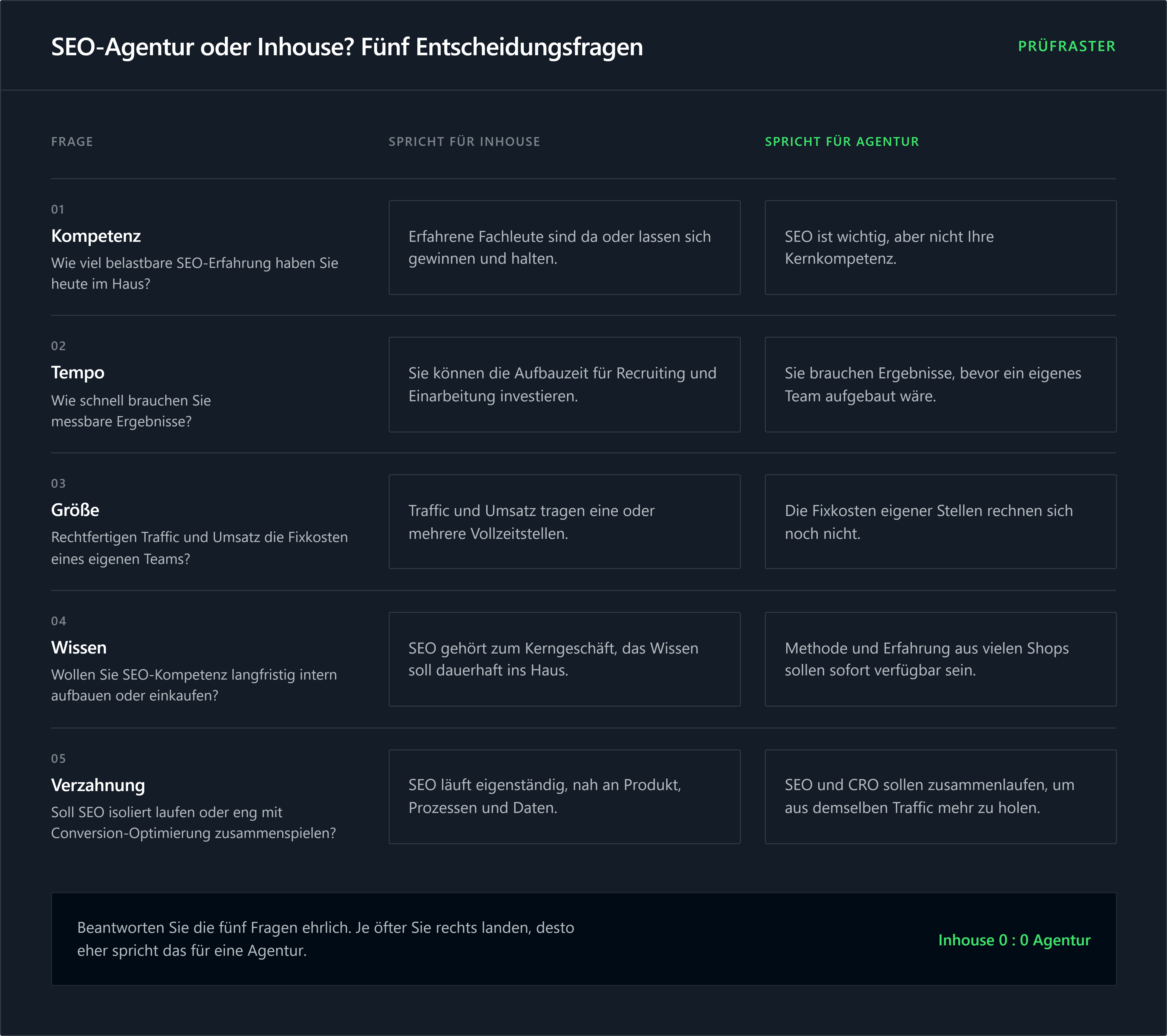
If you answer the following five questions honestly, it usually becomes clear which path is right for you.
The more often you lean toward "fast, no internal team, integrated with CRO," the more an agency makes sense. The more expertise, budget, and desire to build an internal team you have, the more worthwhile an in-house approach becomes. Often, the pragmatic path is a combination: starting with an agency and later transferring knowledge to your own team.
Takeaways
Artificial intelligence does not replace an internal team or an agency, but it does change the tasks they handle. Routine work such as keyword research, technical checks, or creating snippet variations can now be largely automated. This leaves more time on both sides for strategic work: positioning, content quality, and the question of how a brand becomes visible in AI search results. Anyone building an internal team should consider this expertise from the start. Anyone hiring an agency should specifically ask how they are already integrating AI into their work.
Key Takeaways
If you take a closer look at our agency page, you will see that LEAP is data-driven and integrates SEO and CRO. We generate more revenue from the same stream of visitors because we don't treat visibility and conversion as separate entities. Our model can be structured based on performance, meaning we share the risk with you.
Honesty is key here. A good agency doesn't make you dependent on them. We work transparently with your team, share knowledge and data, and explicitly support you even if you want to build expertise in-house. We make our results verifiable with data in published case studies. You can see the details of how we work as an SEO agency on our services page.
Key Takeaways
The five questions from section 4 serve as your checklist, regardless of which path you choose. If you want to find out where your biggest SEO leverage lies and whether an in-house team makes financial sense, a brief initial consultation is the fastest way forward. We will take a look at your current situation and give you an honest assessment of which path makes sense for you.
FAQ
How much does an SEO agency cost? That depends on the scope. An SEO audit typically costs between 4,000 and 7,500 euros, while ongoing support is usually billed via a monthly retainer between 1,500 and 5,000 euros or daily rates between 1,000 and 2,000 euros. The exact amount depends on the level of competition, the scope of work, and your goals. Specific terms are best clarified in a direct conversation, as they depend heavily on the individual case.
How much does an in-house SEO team cost? An experienced in-house SEO manager in Germany currently costs between 3,500 and 5,500 euros gross per month, depending on experience, region, and company size. On top of that, there are costs for SEO tools, professional development, and social security contributions, which can easily add up to several hundred euros per month.
How long does it take for SEO to show results? SEO is a medium- to long-term channel. Initial effects are often visible after a few months, with the full impact building up over a longer period. If you need short-term spikes in revenue, it makes sense to combine SEO with other channels.
Can SEO be done entirely in-house? Yes, provided you have sufficient traffic, budget, access to tools, and experienced professionals. Many shops do well with a hybrid model: an agency provides the methodology and momentum, while your own team takes on more responsibility over time.
At what company size does it make sense to outsource SEO to an agency? There is no fixed threshold, but as a rule of thumb: as soon as organic traffic and revenue are high enough to justify the fixed costs of an in-house team, and you want to build permanent SEO expertise internally, an in-house approach is worth it. As long as that is not yet the case, or if quick results are more important than building internal knowledge, an agency is usually the more economical path.
What is the difference between an SEO agency and a CRO agency? SEO brings in more visitors, while CRO ensures that more of those visitors make a purchase. The strongest results are achieved when both work together, because additional traffic only generates revenue if the site is optimized for conversions.
.png)

About one in four shoppers abandons their cart due to mandatory account creation. Here is how a guest checkout removes the barrier without losing customer accounts.

The cost of conversion optimization depends on a few key factors. Learn about pricing models, cost drivers, and why ROI is the more important figure.

Not every CRO agency tests systematically. These 7 criteria will help you identify reliable providers before you allocate your budget.
Around 73% of top online shops in Germany do not use an A/B testing tool. Here is why this is the biggest untapped lever in e-commerce and what systematic testing actually achieves.
AI search has arrived in German online retail: It used to be about whether an AI answer appeared for your search terms. Today, it is about whether your brand is cited as a source within it.


.png)