€12.4 million in additional revenue through A/B testing!

Watch for free now
New Study: How AI Search is Changing SEO Visibility in E-Commerce
Read now


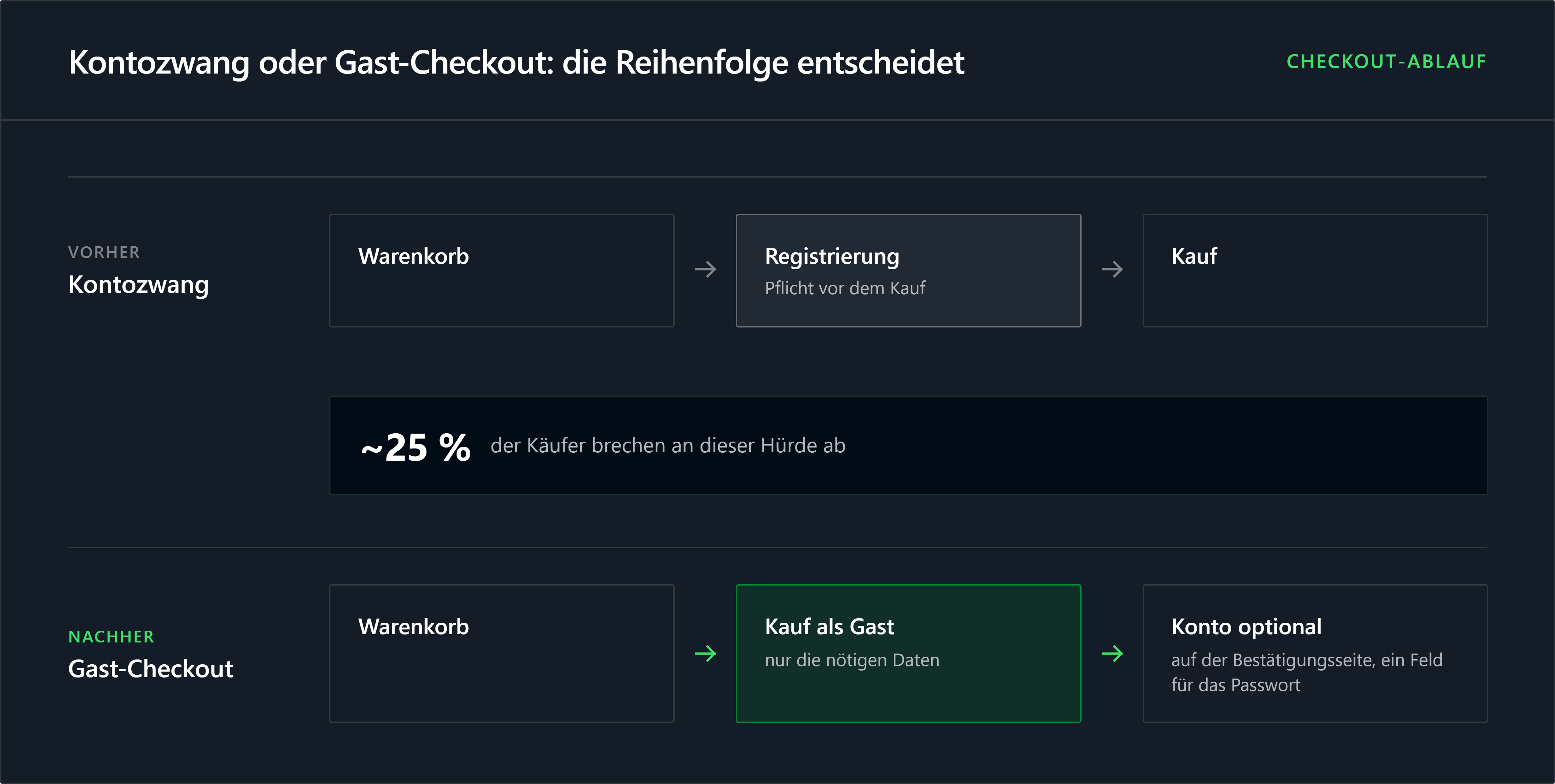
Many online stores require a customer account before a purchase can be made. The reasoning behind this is understandable: registered customers are more likely to return and provide valuable data. However, the price for this is high, as a large portion of first-time buyers drop off at this hurdle.
Around a quarter of shoppers abandon their purchase when an account is forced (Baymard Institute). This is one of the most common and easily fixable reasons for cart abandonment. The solution is not to abandon customer accounts, but to change the order of operations: purchase first, optional account second. This article explains why mandatory accounts are so costly and how to eliminate them without losing registered customers.
1. Why mandatory accounts drive shoppers away
2. What a guest checkout achieves
3. How to implement an effective guest checkout
4. You don't lose customer accounts, you gain them differently
5. Your next step
6. FAQ
Forcing users to register hits buyers at the worst possible moment. First-time shoppers want the product, not another login and password to manage. Creating an account requires effort and a commitment that many aren't ready for at the point of purchase. That is why forced account creation is the second most common avoidable reason for cart abandonment, right after unexpected extra costs.
For you, this means a double loss. You lose the individual sale and, at the same time, the customer you were trying to build a relationship with. In the worst-case scenario, the hurdle intended to create loyalty ends up preventing it.

Key takeaways
A guest checkout allows customers to purchase without prior registration. The customer only provides the information necessary for the order and completes the purchase. This shifts the decision of whether or not to create an account to the end, once the purchase is already successful.
The effect is immediate: the biggest psychological hurdle before checkout is removed. First-time buyers and occasional shoppers who aren't looking for a long-term commitment can breeze through the checkout process. For many shops, this is one of the most direct ways to lower abandonment rates.
Key takeaways
What matters is not just having a guest checkout, but how it is integrated. Make guest checkout the visible default option instead of hiding it behind a login screen. A pop-up that forces users to sign in before checking out is the most common way to accidentally rebuild that barrier.
Offer the account option after the purchase on the confirmation page, using the data already provided. Often, a single additional field for a password is all it takes to turn a guest into a registered customer. If an account offers real value, state it clearly at the point of decision: saved addresses, order history, faster future checkouts. This turns the account into an offer rather than a requirement.
Key takeaways
The most common objection to guest checkout is the fear that no one will register anymore. This is understandable, but it doesn't hold true if the sequence is correct. You still ask for the account, just at a point where it no longer stands in the way: after a successful purchase.
The loyalty effect remains intact. Experience shows that registered customers shop more frequently and complete purchases more often than guests. You aren't giving up this value; you're just no longer paying for it with lost first-time sales. A forced account before the purchase becomes a voluntary one afterward, and voluntary customers are the better ones.
Key takeaways
It is a proven fact that mandatory account creation costs you customers. A test using your own data will show exactly how much it costs your shop and how much of an impact a guest checkout has. However, testing is rare in the market: around 73 percent of top online shops in Germany do not use an A/B testing tool. Those who verify the impact rather than guessing gain a competitive edge.
For a compact introduction with concrete tests, check out our guide "7 Tests for More E-Commerce Profit".
What is a guest checkout? A guest checkout allows customers to make a purchase without having to create an account first. They only enter the data necessary for the order. They can then optionally create an account afterward.
How many shoppers abandon their carts due to mandatory account creation? Around a quarter of shoppers cite forced account creation as a reason for abandonment (Baymard Institute). This makes it the second most common fixable reason, right after unexpected additional costs.
Will I lose my customer accounts? No. You offer the account after the purchase, on the confirmation page, using the data already entered. This maintains customer loyalty without blocking the purchase.
Should guest checkout be the default option? Yes. It is most effective when it is visible and offered as the default, rather than hidden behind a login. A forced login window before checkout simply recreates the barrier.
.png)


Most purchases are abandoned on smartphones. Discover where mobile checkouts fail and the levers you can use to boost your mobile conversion.
Around 7 out of 10 shopping carts are abandoned. Here are the known causes and the levers you can use to specifically lower your abandonment rate.

The cost of conversion optimization depends on a few key factors. Learn about pricing models, cost drivers, and why ROI is the more important figure.

Build SEO in-house or outsource to an agency? Five questions to help you make an honest make-or-buy decision.

Not every CRO agency tests systematically. These 7 criteria will help you identify reliable providers before you allocate your budget.


.png)