€12.4 million in additional revenue through A/B testing!

Watch for free now
New Study: How AI Search is Changing SEO Visibility in E-Commerce
Read now


Few metrics in e-commerce are as sobering as the cart abandonment rate. Over the past few years, it has averaged around 70 percent (Baymard Institute). For every shop, this means: out of ten people who add something to their cart, seven leave again before making a purchase.
The good news is that a large portion of these abandonments have known and fixable causes. Another portion consists of users who are just browsing and had no intention of buying anyway. If you know the fixable reasons and address them specifically, you can noticeably lower your abandonment rate. This article shows you what those causes are and which levers you can use to address them.
1. How high the abandonment rate really is
2. Why users abandon their carts
3. The most effective levers against abandonment
4. From gut feeling to testing
5. Your next step
6. FAQ
The average shopping cart abandonment rate has remained stable for years at around 70 percent, averaged across numerous studies (Baymard Institute). It is even higher on smartphones than on desktops, which is significant because a large portion of traffic today is mobile.
It is important to put this into perspective: not every abandonment is a lost sale. A significant portion—around four out of ten in Baymard's survey—consists of users who are just browsing or are not yet ready to buy. These abandonments are difficult to avoid. The rest, however, have specific causes within the checkout process, and that is where you can make an impact. Baymard quantifies the potential: by simply improving checkout design, a large shop can significantly increase its conversion rate.

Key takeaways
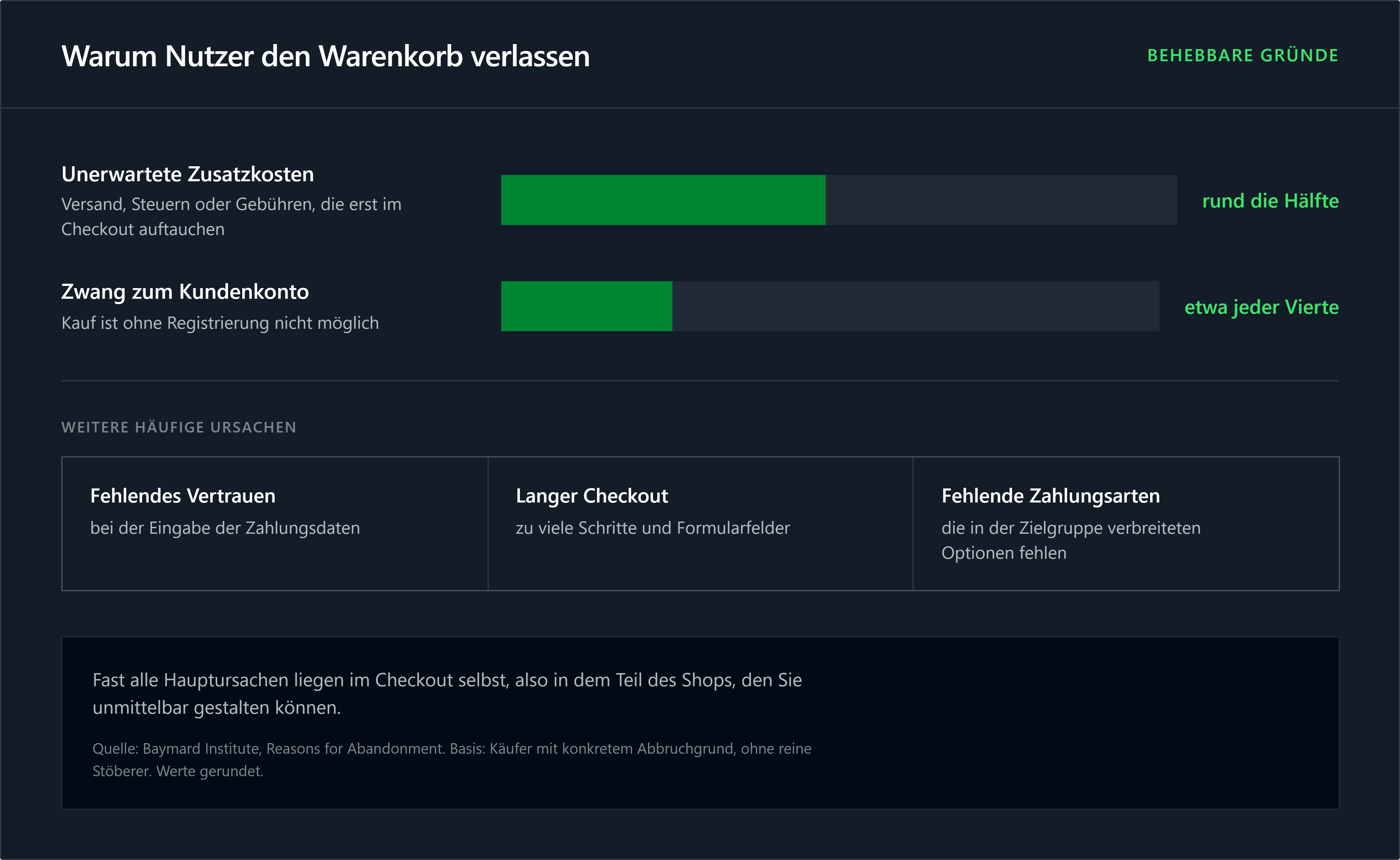
Excluding those who are just browsing, buyers in Baymard's study consistently cite the same reasons. By far the most common are unexpected extra costs: shipping, taxes, or fees that only appear at checkout lead to abandonment for about half of those surveyed. This is followed by the requirement to create a customer account, which about one in four cites as a reason for abandoning.
Other common causes include a lack of trust when entering payment details, a checkout process that is too long or complicated, and a lack of suitable payment methods. It is striking that almost all of these reasons lie within the checkout process itself—the part of the shop that you can directly design and improve.
Key takeaways
These levers follow directly from the causes. Transparency helps combat unexpected additional costs: display shipping costs early, ideally on the product page, and use a clear free-shipping threshold. To address forced account creation, offer a guest checkout that allows purchases without registration, making account creation optional afterward.
You can streamline a checkout that is too long by reducing form fields and only asking for what is truly necessary. Many checkouts display significantly more fields than required. Counteract a lack of trust with visible security signals and recognizable payment logos in the right places. Address missing payment methods by offering the options most popular with your target audience. On smartphones, each of these simplifications pays off double, as abandonment rates are highest there.
Takeaways
The levers mentioned are proven, but only testing will show which ones yield the most for your customers. A guest checkout that reduces abandonment in one shop might do little in another. The solution, therefore, does not lie in the next reminder email, but in the checkout process itself, verified against your own data.
Very few do this. Around 73 percent of top online shops in Germany do not use an A/B testing tool (LEAP × SISTRIX, Autumn 2025). Those who systematically test their checkout levers instead of implementing them based on gut feeling gain a competitive edge. At LEAP, this experience is built on over 4,000 conducted A/B tests. We show the scale of uplift that systematic testing can achieve in our article on the Conversion Rate Benchmark.
Takeaways
If you want to lower your abandonment rate, start with the biggest lever: review your checkout step by step and check it against the causes from section 2. For a compact introduction with concrete tests, see our guide "7 Tests for More E-Commerce Profit".
What is a good cart abandonment rate? The long-term market average is around 70 percent (Baymard Institute). Anything below that is better than average, and a well-optimized checkout typically achieves rates in the 55 to 60 percent range. It is more useful to compare your performance against your specific industry rather than just the global average.
What is the most common reason? Unexpected extra costs during checkout, such as shipping, taxes, or fees that only appear at the final stage. This is also the easiest reason to fix, as transparency and a clear shipping cost policy address the issue directly.
Do cart abandonment emails actually work? They bring back some of the users who abandoned their carts, but they do not address the root cause. If shipping costs are too high, they remain too high even in a reminder email. The greater opportunity lies in preventing these abandonments from happening in the first place.
Is the abandonment rate higher on smartphones? Yes. Mobile carts are abandoned significantly more often than desktop ones. Since the majority of traffic comes from mobile devices, a seamless mobile checkout is one of the most effective levers you can pull.
.png)

About one in four shoppers abandons their cart due to mandatory account creation. Here is how a guest checkout removes the barrier without losing customer accounts.

Most purchases are abandoned on smartphones. Discover where mobile checkouts fail and the levers you can use to boost your mobile conversion.

The cost of conversion optimization depends on a few key factors. Learn about pricing models, cost drivers, and why ROI is the more important figure.

Not every CRO agency tests systematically. These 7 criteria will help you identify reliable providers before you allocate your budget.

Around 73% of top online shops in Germany do not use an A/B testing tool. Here is why this is the biggest untapped lever in e-commerce and what systematic testing actually achieves.


.png)