€12.4 million in additional revenue through A/B testing!

Watch for free now
New Study: How AI Search is Changing SEO Visibility in E-Commerce
Read now


Successful marketing today means understanding buying decisions instead of guessing target groups. The GRIPS® typology provides decision makers with the tools to precisely predict user behavior — and to increase conversions in a targeted manner. Anyone who knows which GRIPS® type is sitting in front of them builds trust, optimizes budgets and secures competitive advantages.
1. What are the five GRIPS® types — and how they shape purchasing decisions.
2. How to tailor your communication, pricing, and customer journey
3. Why GRIPS® 2025 is the direct ROI lever in marketing.
1. What are the five GRIPS® types — and how they shape purchasing decisions.
2. How to tailor your communication, pricing, and customer journey
3. Why GRIPS® 2025 is the direct ROI lever in marketing.
The GRIPS® typology depicts target groups more precisely than traditional models because it focuses on purchasing decisions — not on age, income or demographics. Who knows how customers really make decisions, optimizes their conversion rates, increases sales and builds trust in the long term.
Traditional target group models segment by age, gender, or place of residence. The problem: These factors say little about why a customer actually buys — or why they cancel the purchase.
The GRIPS® typology, developed by Vocatus AG, takes a different approach. It classifies purchasing decisions into five types, which are based on behavioral economics principles. This brings the focus to the how and why of the decision.
The special thing about it:
As a result, the typology provides a clear advantage: Marketing and sales can align their communication, prices and customer journeys with the real logic of buyers — and not with superficial assumptions.
Every purchase decision follows certain patterns — even if it seems chaotic at first glance. This is exactly where the GRIPS® typology comes in: It reduces the seemingly infinite variety of human decision-making processes to five clearly distinguishable types. These types are not tied to age, gender, or income, but reflect the psychological drivers behind buying decisions.
For you as a decision maker, this means that if you know which GRIPS® type your customers represent, you can tailor your offers, communication and conversion strategy more precisely — and minimize wastage.

There are five GRIPS® types © Vocatus AG
1. The bargain hunter
The bargain hunter is constantly looking for the best deal. He is less concerned with the cheapest product per se and more about the feeling that he has made a clever deal. This sense of achievement drives him — often regardless of actual needs. That is why he likes to rummage through online shops, regularly compare prices and knows the market conditions very well.
It is characteristic:
Marketing levers: Flash sales, exclusive deals, countdown offers. Transparency and honesty are crucial — when bargain hunters realize that discounts are artificial, they immediately lose trust.
2. The winner
The winner decides according to the motto: “Quality has its price.” For him, value, brand image and a convincing story are more important than the discount. He is quite prepared to go over budget if it makes him feel like he is treating himself to something special. This type of person sees the buying process itself as an experience — advice, service and presentation play a central role.
It is characteristic:
Marketing levers: Lean processes, clear product texts, quick orientation. For this type, simple navigation is more important than sophisticated campaigns or emotional communication.
4. The loss averse
The loss averse decides extremely carefully. He is afraid of making the wrong choice and sees every purchase as a potential risk. Attractive offers, too many options or small print reinforce this uncertainty. A certain skepticism towards new suppliers or unknown shops is also typical.
It is characteristic:
Marketing levers: Communicate security. This is achieved through trustworthy payment options, quality seals, transparent return and warranty conditions, and clear, easy-to-read communication. Visual confirmations (“Your order was successful”) along the customer journey are also recommended.
5. The habitual buyer
The habitual buyer is not looking for variety — he wants continuity and reliability. Once he trusts a brand or provider, he remains loyal to it for a long time. Price comparisons play a subordinate role for him as long as service and quality are right. However, changes in the offer or design can quickly unsettle him.
It is characteristic:
Marketing levers: customer loyalty programs, service quality, consistent brand management. If you want to win this type, you have to radiate reliability — abrupt changes in design, product lines or communication are risky.
This makes it clear that each type has its own driving forces, barriers and triggers. The GRIPS® typology makes it possible to use precisely these mechanisms — for a more precise approach and higher conversion rates.
In marketing by 2025, it is no longer enough to describe target groups with classic personas. Users navigate fragmented customer journeys, switch devices and channels — and make their purchase decisions under psychological influences that cannot be captured with socio-demographic data.
The GRIPS® typology provides guidance here:
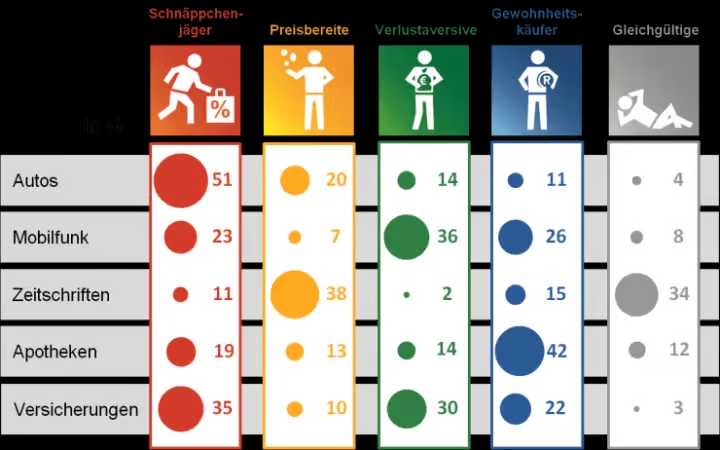
Practical example How do discounts work © Vocatus AG
The GRIPS® typology is not a theoretical construct, but a practical control tool. It shows how buying decisions really arise — and how you can influence them.
Anyone who analyses their target group on this basis achieves three effects:
In short: GRIPS® brings psychology directly into marketing — and makes it a growth driver.

.png)

About one in four shoppers abandons their cart due to mandatory account creation. Here is how a guest checkout removes the barrier without losing customer accounts.

Most purchases are abandoned on smartphones. Discover where mobile checkouts fail and the levers you can use to boost your mobile conversion.

Around 7 out of 10 shopping carts are abandoned. Here are the known causes and the levers you can use to specifically lower your abandonment rate.

The cost of conversion optimization depends on a few key factors. Learn about pricing models, cost drivers, and why ROI is the more important figure.

Build SEO in-house or outsource to an agency? Five questions to help you make an honest make-or-buy decision.


.png)