€12.4 million in additional revenue through A/B testing!

Watch for free now
New Study: How AI Search is Changing SEO Visibility in E-Commerce
Read now


The discussion about AI search is often conducted along a simple narrative: fewer clicks, less traffic, less visibility.
But the data show a different picture. While AI-driven search systems currently account for only a very small proportion of total traffic, they also deliver significantly higher quality per visitor.
The central finding:
It is not the volume of traffic that is fundamentally changing, but its value.
This not only changes the performance of individual channels, but also the logic of how revenue and growth in digital marketing are generated.
As a result, the central control variable in marketing is moving all the more away from reach and towards conversion.
The data is clear: Visitors from AI systems such as ChatGPT or Perplexity convert more than four times better on average than traditional organic users.
In concrete terms, this means that an individual AI visitor can make a significantly higher economic contribution than an average visitor from the classic search.
As a result, a small share of AI traffic can make a disproportionate contribution to sales. At the same time, the share of this traffic currently remains low while maintaining strong growth.
This combination is decisive: A small channel with a disproportionately high impact.
The difference is not in the channel itself, but in the state of the user.
AI systems take over a large part of traditional research work. They compare providers, structure information and provide a curated basis for decision-making even before the click.
The result:
Users no longer come to a website during the exploration phase, but significantly further in the decision-making process.
The funnel is shortened before the click.
AI performs several functions at the same time:
If a user clicks afterwards, the decision has often already largely been made.
This behavior can be described as “pre-qualified intent.”
The user has already clarified their requirements, evaluated options and made a pre-selection.
The click is therefore no longer the start of the customer journey, but its continuation.
The actual decision-making process has already taken place at this stage — outside of the company's own website.
This explains the significantly higher conversion rates.
In individual cases, the conversion rate of AI traffic is many times higher than traditional organic traffic.
This difference is not an optimization effect, but is structural.

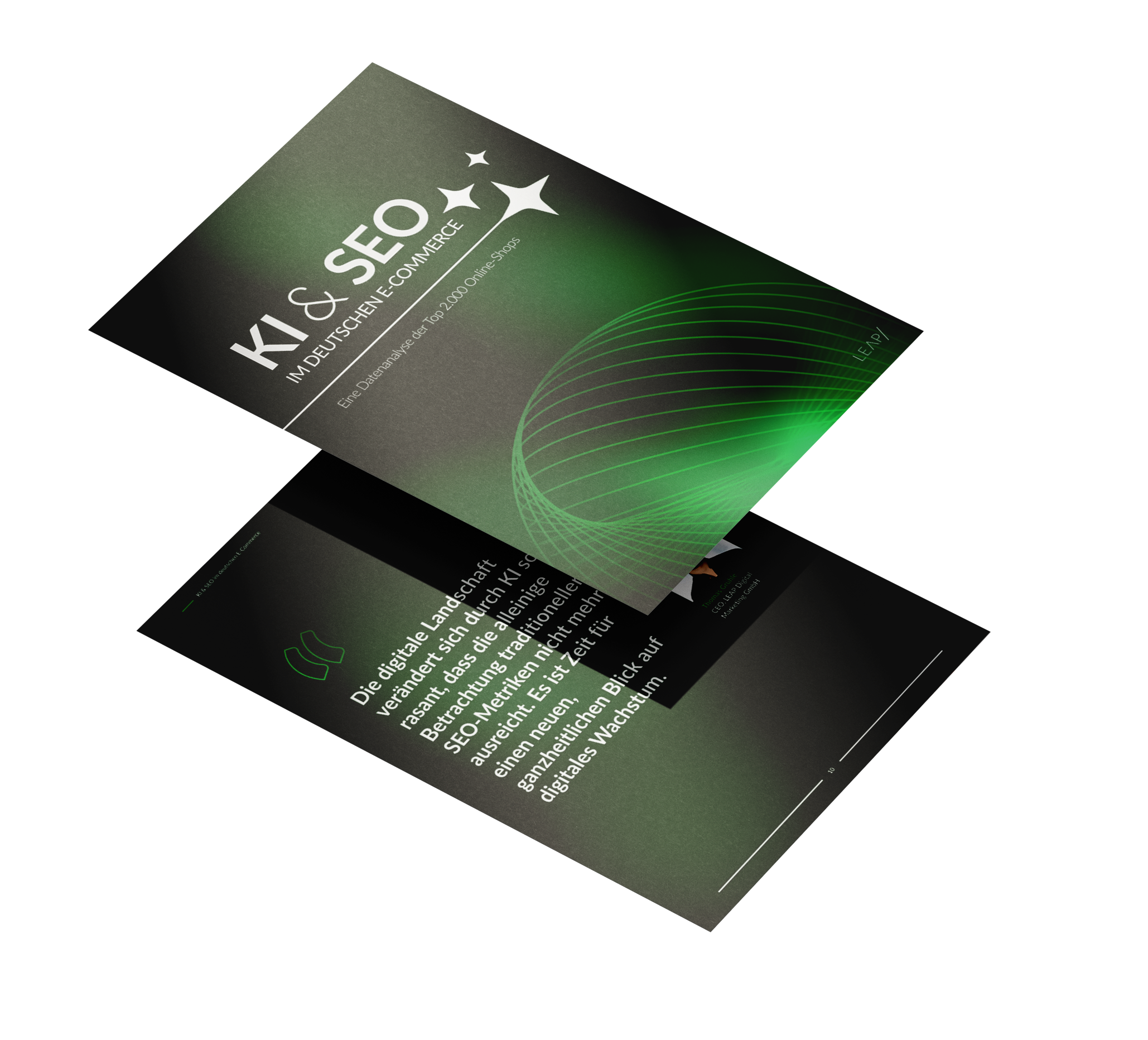
Fewer clicks, but more revenue? Our free study provides the data you need: we analyzed around 2,000 of Germany’s most successful online shops to examine AI Overviews, AI modes, and their impact on conversions. Secure the key takeaways for your strategy now.
Many companies respond to AI searches with the question: “How do I write content for ChatGPT and Co.? “The better question is: “What content helps a user make a concrete decision? ”
Because it is precisely this content that AI systems prefer to use. Not because they are “AI-compatible,” but because they are precise, structured and resilient.
AI systems can only work with what is clearly formulated on the website. Vague statements such as “leading”, “innovative” or “tailor-made” are hardly usable for a model. Content that provides clear answers can be used.
Good, AI-compatible content meets three criteria:
1) It answers a specific decision question
examples:
2) It is structured rather than narrative
Clear headings, short paragraphs, tables, comparison blocks and FAQ formats are not only user-friendly, but can also be easily interpreted by machine.
3) It contains reliable facts
Figures, restrictions, framework conditions and concrete results make content citable. The more specific the statement, the more likely it is to be incorporated into AI responses.
When the goal is conversion, these formats are particularly effective (depending on the industry):
These formats reduce uncertainty. And uncertainty is usually the main reason why pre-qualified users don't convert.
AI search doesn't automatically reduce revenue. In particular, it reduces the number of clicks that have no real intention of closing. This is not a loss, but a shift in efficiency.
For companies, the consequences are clear:
Anyone who continues to primarily optimize for reach will see traffic but have less effect.
On the other hand, if you focus content, landing pages and measurement on pre-qualified users, you can generate more revenue with fewer visits.
The practical implementation is not complicated, but consistent:
That is exactly where the difference between “more visitors” and actual growth lies.
.png)

About one in four shoppers abandons their cart due to mandatory account creation. Here is how a guest checkout removes the barrier without losing customer accounts.

Most purchases are abandoned on smartphones. Discover where mobile checkouts fail and the levers you can use to boost your mobile conversion.

Around 7 out of 10 shopping carts are abandoned. Here are the known causes and the levers you can use to specifically lower your abandonment rate.

The cost of conversion optimization depends on a few key factors. Learn about pricing models, cost drivers, and why ROI is the more important figure.

Build SEO in-house or outsource to an agency? Five questions to help you make an honest make-or-buy decision.


.png)