€12.4 million in additional revenue through A/B testing!

Watch for free now
New Study: How AI Search is Changing SEO Visibility in E-Commerce
Read now


Choosing your SEO agency is one of the most important decisions for your digital growth. SEO is no longer just a marketing channel — it is a Sales and profit levers, which decides on visibility, market shares and brand trust.
But this is exactly where the problem lies: The market is confusing, the promises are great, and SEO remains a black box for many decision makers. If you vote incorrectly here, you risk wasting your budget, losing your ranking or even damaging your reputation.
To prevent this from happening to you, this guide provides you with a clear roadmap of how to find the right partner — and how to evaluate it on an ongoing basis.
1. Why clear goals and a realistic budget are the basis for agency search
2. Which sources should you use to identify reputable providers
3. How do you distinguish competence from empty promises in the initial interview
4. Why a test project is essential before a long-term commitment
5. Which KPIs and reports are decisive for quality control
6. How AI makes the difference between buzzword bingo and real competitive advantage
1. Why clear goals and a realistic budget are the basis for agency search
2. Which sources should you use to identify reputable providers
3. How do you distinguish competence from empty promises in the initial interview
4. Why a test project is essential before a long-term commitment
5. Which KPIs and reports are decisive for quality control
6. How AI makes the difference between buzzword bingo and real competitive advantage
Before you even start looking for an SEO agency, you need to know what you want to achieve. SEO is not an end in itself — it is a growth lever. But whether your goal is more leads, higher sales in the online shop or a stronger brand presence: Only when you formulate clear goals can you judge whether an agency really delivers.
A realistic budget is just as important. High-quality SEO work requires experience, strategic expertise and resources. Dumping prices are a warning sign — you risk ineffective measures, ranking losses or, in the worst case, a Google penalty that costs you significantly more in the long term.
Criteria list: Questions you must answer before you search
Only when you have answered these questions clearly can you meaningfully explore the market.
Google searches for “SEO agency” may give you millions of results — but that's just the start. A serious pre-selection requires that various sources be included: trade magazines, conferences such as SMX or OMR, as well as personal recommendations from your network. There you can see which agencies have substance in terms of content and don't just shine with buzzwords.
References are an important selection criterion. But be careful: A logo slider with big brands doesn't say much. Ask what role the agency actually played and what results were achieved. Good agencies communicate this transparently — even if they are unable to reveal all details for reasons of confidentiality.
Insight
Don't rely on glossy references alone. Check whether the agency really stands behind the successes — or whether it only acted as a small supplier in the background.
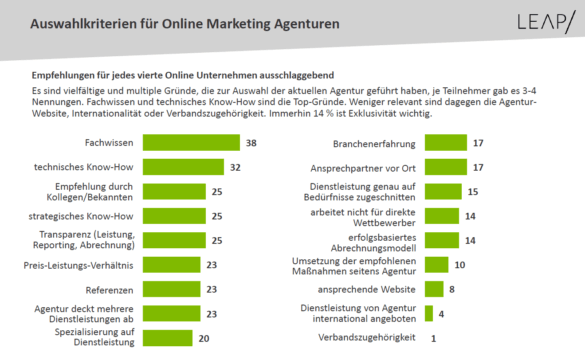
What our customers say about their most important selection criteria
The initial conversation is crucial to differentiate between real experts and sales professionals. Pay attention to how the agency picks up on your goals and what questions they ask. A reputable partner will not fob you off with standard solutions, but will want to understand your individual situation.
Warning signs during the initial consultation
A positive sign is when an agency gives you time: for preparation, for a thorough analysis and for building a trusting collaboration. Good agencies are often booked out in advance and do not push for a quick contract conclusion.
Practical checklist: Questions for your initial consultation
When the answers are clear, transparent and comprehensible, you're one step closer to finding the right partner.
Before you commit yourself to an agency in the long term, you should test the collaboration within a manageable framework. A pilot project shows you whether the agency keeps its promises, how communication works and whether the chemistry is right.
It is important that KPIs, roadmaps and responsibilities are clearly defined right from the start. This is the only way you can objectively assess whether the results meet expectations.
Also pay attention to fair contract terms. Long minimum terms without a cancellation option are a warning sign. A reputable agency is convinced of its added value — and gives you the opportunity to flexibly end the collaboration if it doesn't suit you.
A cleanly executed test project is therefore not only a sign of quality, but also protects you from costly mistakes.
Choosing an SEO agency is not a one-time process. You must constantly review the collaboration. This is the only way to ensure that measures do not fly blindly and that your investment delivers real business impact.
You should regularly review these KPIs:
Reporting is at least as important as figures. Reputable agencies not only provide colorful charts, but clear recommendations for action: What does the development mean for your business, what opportunities are there and where are the risks?
Tip:
Insist on reporting that provides a basis for decision-making — not just status reports. Good reporting answers the question: “What does that mean specifically for sales, profitability and next steps? ”
Even with a good agency, problems can arise. Misunderstandings often arise because expectations have not been formulated clearly enough — or because there is a lack of resources on both sides.
Typical tripping hazards:
Here's how to avoid problems:
Successful SEO is teamwork. If both sides communicate openly and in a structured manner, most pitfalls can be avoided right from the start.
SEO is changing rapidly — and artificial intelligence has long been one of the biggest levers. But not every agency that advertises “AI” makes good use of the technology. For you as a decision maker, it's about identifying agencies, the AI Use strategically — and not just as a buzzword.
How do you recognize serious use of AI:
If an agency can show you exactly how to integrate AI into the SEO process — without replacing human expertise — then you're on the right track. The combination of AI efficiency and strategic know-how will determine competitive advantages in 2025/26.
The right SEO agency is not a stroke of luck, but the result of clear criteria and structured testing. It fits your goals, works transparently and not only delivers rankings, but verifiable business impact.
If you approach the selection professionally, you avoid the typical pitfalls — from unrealistic promises to lack of communication to ineffective measures. Instead, make sure that SEO becomes a real growth engine for your business.
Takeaway
You can recognize the perfect SEO agency by the fact that they:
In the end, it's not about first place on Google, but about profitable growth. A good agency makes exactly that difference.

.png)

About one in four shoppers abandons their cart due to mandatory account creation. Here is how a guest checkout removes the barrier without losing customer accounts.

The cost of conversion optimization depends on a few key factors. Learn about pricing models, cost drivers, and why ROI is the more important figure.

Build SEO in-house or outsource to an agency? Five questions to help you make an honest make-or-buy decision.

Not every CRO agency tests systematically. These 7 criteria will help you identify reliable providers before you allocate your budget.

Around 73% of top online shops in Germany do not use an A/B testing tool. Here is why this is the biggest untapped lever in e-commerce and what systematic testing actually achieves.


.png)