€12.4 million in additional revenue through A/B testing!

Watch for free now
New Study: How AI Search is Changing SEO Visibility in E-Commerce
Read now


Good Google rankings no longer protect against AI invisibility. This is because Google visibility and AI visibility have become two distinct concepts that operate under different rules.
AI systems like ChatGPT, Perplexity, and Google AI Mode are increasingly determining which brands appear as relevant answers. They make this decision not based on rankings, but on how clearly, consistently, and decision-relevantly a brand communicates overall.
This article demonstrates where traditional SEO logic reaches its limits, what truly drives growth today, and why this is especially relevant for industries where trust and the need for consultation play a central role. Initial analyses suggest that sectors like legal, finance, health, and insurance generate more AI traffic than other industries.
1. Where traditional SEO reaches its limits
2. What drives SEO growth today
3. Conclusion: AI invisibility arises from technical and strategic causes
The fundamentals of SEO remain relevant. Technically clean pages, correct indexing, structured markup: nothing else works without them. However, the activities that consume a large portion of the SEO budget no longer produce the same growth effect as they did three years ago. This isn't due to poor execution, but to a structural shift in search behavior.
Keyword research as an isolated deliverable has lost strategic substance. Search volumes have become unreliable because AI systems like Google AI Mode, ChatGPT, or Perplexity answer informational queries directly before they can be measured as a click. Guide articles, which previously reliably generated traffic, are losing this function because the answer already appears in the search interface.
High-volume content production only works if the content offers something unique that isn't available elsewhere. This includes original data, concrete results, or a clear point of view. Content that could just as easily have been written by any other provider increasingly ranks poorly and barely converts even when it does rank. More pages without a clearer positioning simply multiply the same generic statements, creating more surface area but not a clearer overall picture.
Internal linking, title tags, H1 structures: all of these have their place, and those who neglect them will fall behind. However, anyone who allocates 40 percent of their SEO budget to on-page work and treats that as a strategy is merely optimizing the foundation without building anything substantial upon it.
A technical aspect is often overlooked: Many websites unintentionally block AI crawlers like CCBot, GPTBot, or ClaudeBot because a CDN or firewall has this set as a default. If your content isn't crawled by these systems, it won't be included in the training of language models, and consequently won't appear in the answers these systems later provide. This is not a niche topic, but a fundamental question for today's SEO infrastructure.

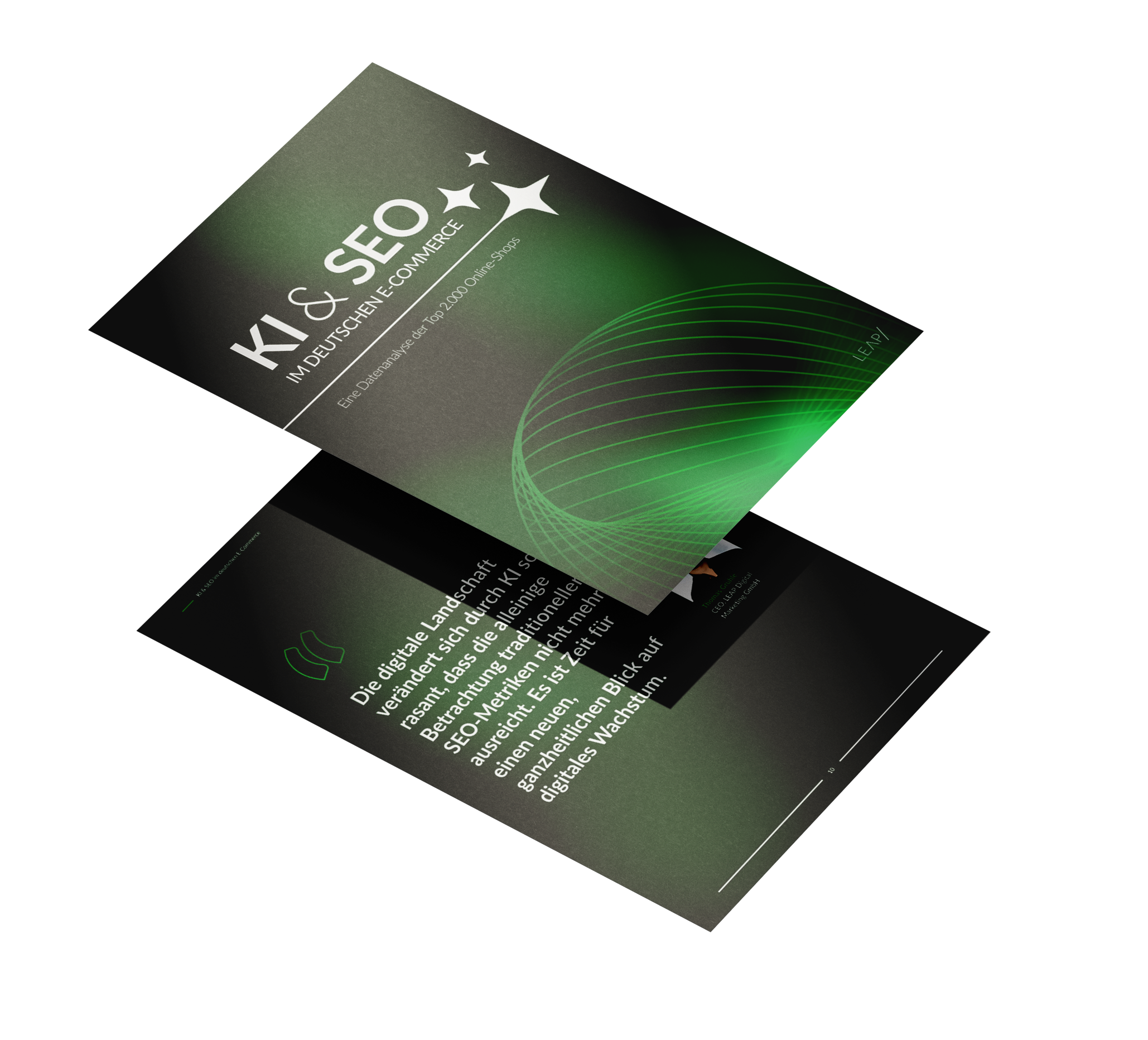
How are AI Overviews and AI Mode actually impacting e-commerce visibility? Our free study provides you with data-driven insights from nearly 2,000 online shops, along with actionable key takeaways for your SEO strategy.
The question is not whether SEO still works. It is: What SEO work actually generates growth today? The answer is shifting away from page-centric thinking towards brand-centric thinking, away from content volume towards decision relevance, away from waiting towards actively building visibility.
AI systems evaluate companies not based on individual pages, but on the overall picture. They gather information from hundreds of sources: their own website, mentions in specialist media, backlinks, structured data, descriptions on third-party platforms. If these sources present a consistent picture, the company is recognized as a clear entity and recommended accordingly. If not, interpretation effort arises, and systems tend to recommend clearer alternatives.
Generic statements like "holistic solutions for companies of all sizes" don't work as a classification aid for users or AI systems. Describing services more precisely, clearly naming target groups, explicitly stating differences from competitors, using terms consistently across all pages and channels: this is SEO work today, even if it feels more like positioning.
What AI systems prefer to cite and what truly converts users are content that answers specific questions: Who is this suitable for, and who is it not? What does it cost in practice? How long does implementation take? What alternatives are there?
Comparison pages, use-case descriptions by problem instead of product category, FAQ pages with practical answers: these are the formats that work today because they reduce uncertainty. Uncertainty is usually the main reason why someone doesn't convert, even if they show interest.
This effect is particularly pronounced in industries with a high need for consultation and trust. Initial analyses indicate that insurance companies, financial service providers, and energy suppliers receive a disproportionately high amount of AI traffic, more than e-commerce or SaaS. The reason lies in the nature of search queries: Anyone comparing disability insurance, switching electricity providers, or checking a loan asks complex, multi-stage questions. AI answers precisely these questions before the click. Those who arrive in these industries have often largely prepared their decision. The conversion probability is correspondingly higher. This is not an argument against SEO in these industries. It is an argument for providing the right content.
Whether a company appears in AI answers also depends on its presence in the sources these systems draw from: specialist media, industry portals, podcast mentions, links from other companies. The assumption that good content automatically spreads has always been half-true. Today, it's even less so.
This is not PR for its own sake. It's about whether AI systems find enough external signals to classify a company as a relevant answer to a specific query. Those who don't actively manage this leave an incomplete picture for these systems, regardless of how well their own website is optimized.
Those who continue to primarily manage by traffic volume get a distorted picture. Users from AI systems often do not appear correctly in standard analytics setups because referrers are not passed cleanly. At the same time, early analyses show that this traffic has significantly higher conversion rates than classic organic traffic: Users arrive further along in the decision-making process because AI has already taken over the research work.
The right key metric is therefore no longer traffic volume, but revenue or leads per user. If you don't measure this, you're optimizing the wrong thing.
Keyword research, content production, and on-page optimization are still necessary. They are just no longer sufficient. Anyone ignored by AI systems today usually has one of two problems, often both simultaneously.
The first is technical and solvable: The website is simply not accessible to AI crawlers. This happens more often than expected because CDN settings or firewalls block bots like CCBot, GPTBot, or ClaudeBot by default. The first concrete step is therefore a simple check: examine robots.txt for disallow rules for AI agents, query the server with the CCBot user agent, and verify if the response is 200 or 403. If blocked, open access and start becoming visible in the training of language models.
The second is strategic and takes more time: The brand is too vague for AI systems to be considered a clear answer to a search query. Specifically, this means: describe services on the website more precisely, clearly define target audiences, explicitly highlight differences from competitors, and consistently use the same terms across all pages and channels. In parallel, it's worthwhile to actively build visibility in the sources from which AI systems draw: trade media, industry portals, structured data with Schema markup.
The simplest self-diagnosis for both: Enter your own brand and key products directly into various AI systems and see if and how you appear. And ask a developer if GPTBot and similar AI crawlers even have access to the website.
This is the baseline. Without it, all further SEO and GEO measures are built on a foundation that might not even hold.
.png)


About one in four shoppers abandons their cart due to mandatory account creation. Here is how a guest checkout removes the barrier without losing customer accounts.

The cost of conversion optimization depends on a few key factors. Learn about pricing models, cost drivers, and why ROI is the more important figure.

Build SEO in-house or outsource to an agency? Five questions to help you make an honest make-or-buy decision.

Not every CRO agency tests systematically. These 7 criteria will help you identify reliable providers before you allocate your budget.

Around 73% of top online shops in Germany do not use an A/B testing tool. Here is why this is the biggest untapped lever in e-commerce and what systematic testing actually achieves.


.png)