€12.4 million in additional revenue through A/B testing!

Watch for free now
New Study: How AI Search is Changing SEO Visibility in E-Commerce
Read now


Many SaaS companies are currently investing heavily in content for AI search.
More landing pages, more use cases, more blog articles. The underlying assumption is simple: Whoever produces more relevant content is considered more often — by Google, ChatGPT, and other AI systems.
Operationally, this is true: Content can be produced faster, cheaper and on a larger scale than ever before.
Strategically, however, the picture is different. In many cases, it is precisely this scaling that does not lead to more visibility, but to increasing interchangeability. Content is becoming more common but indistinguishable.
The reason is not the content itself, but the logic of the systems. AI reinforces existing patterns. When a product is not clearly positioned, this blur is reproduced with every additional content.
That is the real challenge: Content is becoming more efficient, but not automatically more effective.
1. AI search is changing how SaaS products are rated
2. The actual bottleneck lies in content: Positioning determines impact
3. Conclusion: More content doesn't solve a differentiation problem
AI search is particularly relevant for SaaS companies because buying decisions are rarely made impulsively. Users compare functions, check integrations and try to understand which solution fits their specific use case.
It is precisely this phase that is increasingly shifting to AI systems. Instead of analyzing several provider websites, users receive structured classifications: What tools are there, how do they differ and when is which useful.
This is changing the role of the website. It no longer creates the selection, but confirms it.
The decisive effect: Content must not only be correct, but also clearly distinguishable.
Many SaaS content continues to be feature-based. Features are described, advantages are listed, possible uses are roughly outlined.
This is too unspecific for AI systems. Such content is recognizable, but difficult to differentiate from one another.
Content only becomes relevant when it answers clearly:
The clearer this classification is, the more likely that content will be included in a specific request.
Content is very similar in many SaaS categories. Vendors describe similar functions, use similar terms, and address similar use cases.
When such content is scaled, there is no additional benefit.
There is no reason for a system to prefer one solution over another. Content becomes interchangeable because it doesn't provide a clear difference.
The bottleneck therefore lies not in the visibility of individual pages, but in the ability to clearly differentiate oneself in terms of content.

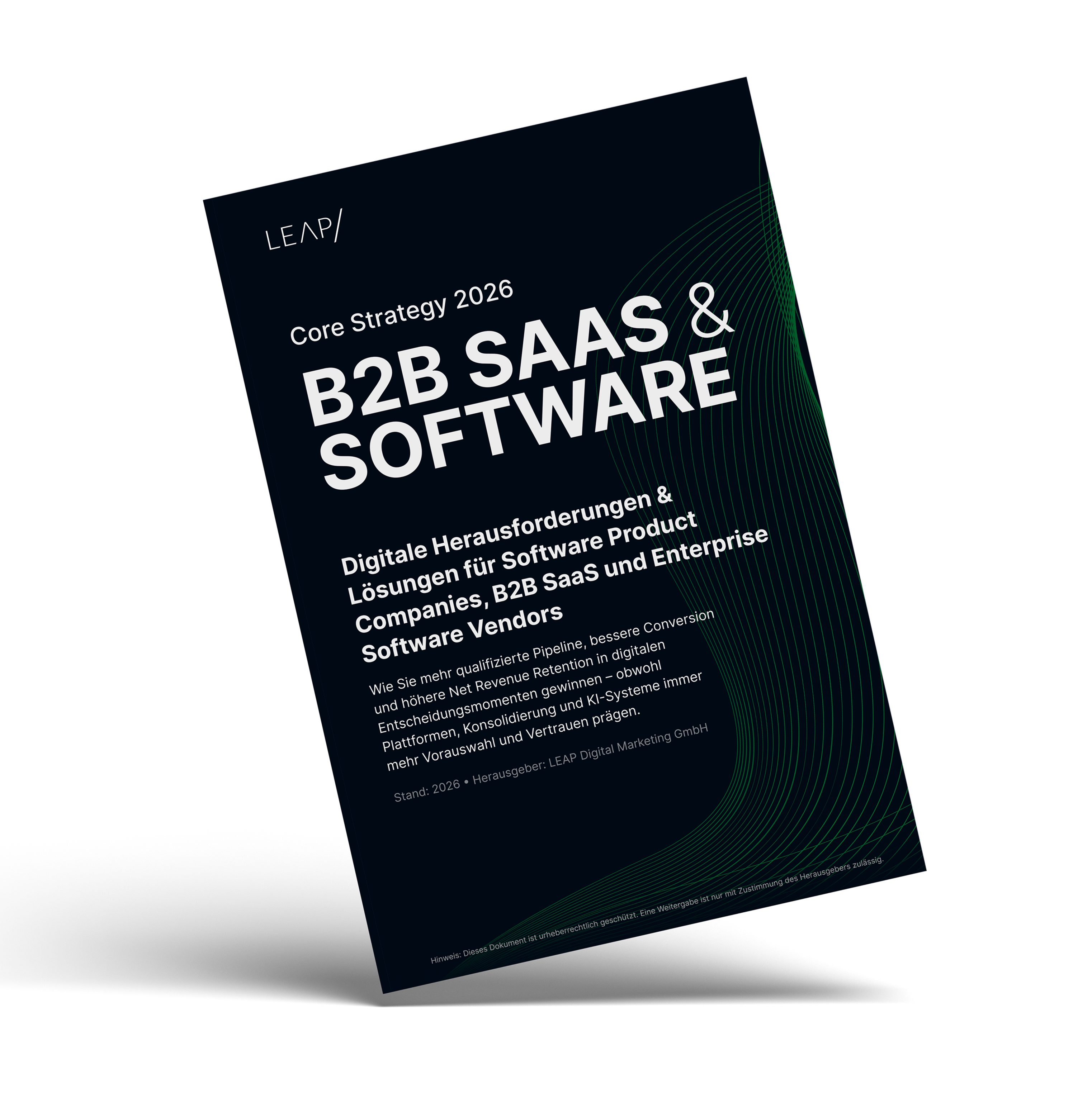
4 out of 5 B2B buyer journeys now take place without any direct contact with a vendor – are you prepared? Our free strategy guide shows you how to secure predictable, profitable growth despite rising CAC and the shift toward AI-driven research.
The central question is not how content is produced, but what it is based on.
If a product is not clearly positioned, it is also impossible to formulate clear content. Statements remain general, differences are not identified and content loses sharpness.
This is exactly where the problem of many SaaS companies occurs: Content is scaled without the underlying positioning being clarified.
AI systems work with existing patterns. They recognize what is already being communicated and reproduce that logic.
When content is already interchangeable, scaling results in:
The problem is not the quantity, but the starting point.
In practice, there is often a lack of clarity on fundamental points:
If these questions are not answered, generic content is bound to be created — regardless of how well it is formulated.
The consequence is not to produce less content, but to structure it differently:
Only on this basis can content have a differentiating effect at all.
As a result of the pre-selection made by AI systems, all providers are no longer competing with each other, but only those that are actually recognized as an independent option.
For many SaaS companies, that is exactly the problem.
Your content is accurate, complete, and cleanly structured. But they don't provide a clear reason why one's own product should be preferred over others.
As long as that is the case, more content won't change the result.
It only ensures that the same statements occur more frequently.
The decisive question is therefore not how much content is produced, but whether this content enables a clear decision.
In concrete terms, this means:
If these points are missing, content will continue to be indexed but will be selected less frequently.
The consequence of this is not to invest less, but to prioritize differently: First the difference, then the scaling.
.png)


About one in four shoppers abandons their cart due to mandatory account creation. Here is how a guest checkout removes the barrier without losing customer accounts.

The cost of conversion optimization depends on a few key factors. Learn about pricing models, cost drivers, and why ROI is the more important figure.

Build SEO in-house or outsource to an agency? Five questions to help you make an honest make-or-buy decision.

Not every CRO agency tests systematically. These 7 criteria will help you identify reliable providers before you allocate your budget.

Around 73% of top online shops in Germany do not use an A/B testing tool. Here is why this is the biggest untapped lever in e-commerce and what systematic testing actually achieves.


.png)