€12.4 million in additional revenue through A/B testing!

Watch for free now
New Study: How AI Search is Changing SEO Visibility in E-Commerce
Read now


Customers no longer think in terms of channels — they expect a seamless experience across online and offline. Connecting these worlds increases conversions, reduces purchase cancellations and increases loyalty. Omnichannel is therefore not a trend for decision makers, but can be a massive growth driver.
1. Why online and offline channels are not opposites — and how customers actually buy today
2. Which strategies and best practices measurably increase omnichannel conversions
3. How decision makers manage budgets, processes and resources in such a way that both channels become engines of growth.
1. Why online and offline channels are not opposites — and how customers actually buy today
2. Which strategies and best practices measurably increase omnichannel conversions
3. How decision makers manage budgets, processes and resources in such a way that both channels become engines of growth.
Brick-and-mortar retailers are struggling with empty stores, online retail is growing unabated — but the real success factor is not either/or. Customers no longer think in terms of channels. They research online, buy offline — or vice versa. For decision makers, this means that anyone who cleverly combines online and offline measures increases conversions, reduces buying risks and builds sustainable customer loyalty.
The alleged separation of online and offline worlds only exists in corporate structures, not in the minds of customers. They choose the channel that offers them the greatest added value in each situation: price advantages, immediate availability, trust or convenience.
The problem for many companies: Marketing and sales think in silos. This creates breaks in the customer journey that unsettle customers and prevent sales from being completed. Decision-makers must therefore move away from channel thinking — towards an omnichannel approach in which all measures contribute to one goal: a seamless experience that promotes conversions.
In order to exploit the full potential, clarity is needed about the specific strengths of online and offline channels:
For decision makers, this means that both worlds complement each other, they do not replace each other. If you strategically orchestrate the synergies, you turn the search for information into a purchase — and visitors into loyal customers.
Today, search and information behavior almost always starts digitally. Customers check reviews, check prices, and compare providers — before they even set foot in a store. This is a huge opportunity for decision makers: Online measures can directly boost stationary sales.
examples:
The principle: Digital marketing must not only aim at online sales, but must consistently focus on the influence on the branch. Anyone who bridges the media gap here gains market shares — on both sides.
Just as online paves the way to business, stationary retail can boost digital sales. Because what customers experience in stores determines their trust in the brand and offer — and this trust has an effect when they buy online later.
Douglas, for example: Flagship stores that offer skin analyses, treatments and expert advice create an experience that cannot be displayed online. This trust directly contributes to online purchases.
For decision makers, this means that offline is not a “remaining stock”, but a brand building and conversion machine. High-quality advice, experience presentation and consistent services (e.g. return offline, order online) create loyalty. And retention lowers the costs of future conversions — no matter on which channel.
Omnichannel is more than just a presence in two channels. Successful companies design the customer journey in such a way that users don't feel any breaks. Decision-makers must therefore consciously create processes that Digital and stationary are seamlessly intertwined.
Best practices that have stood the test of time:
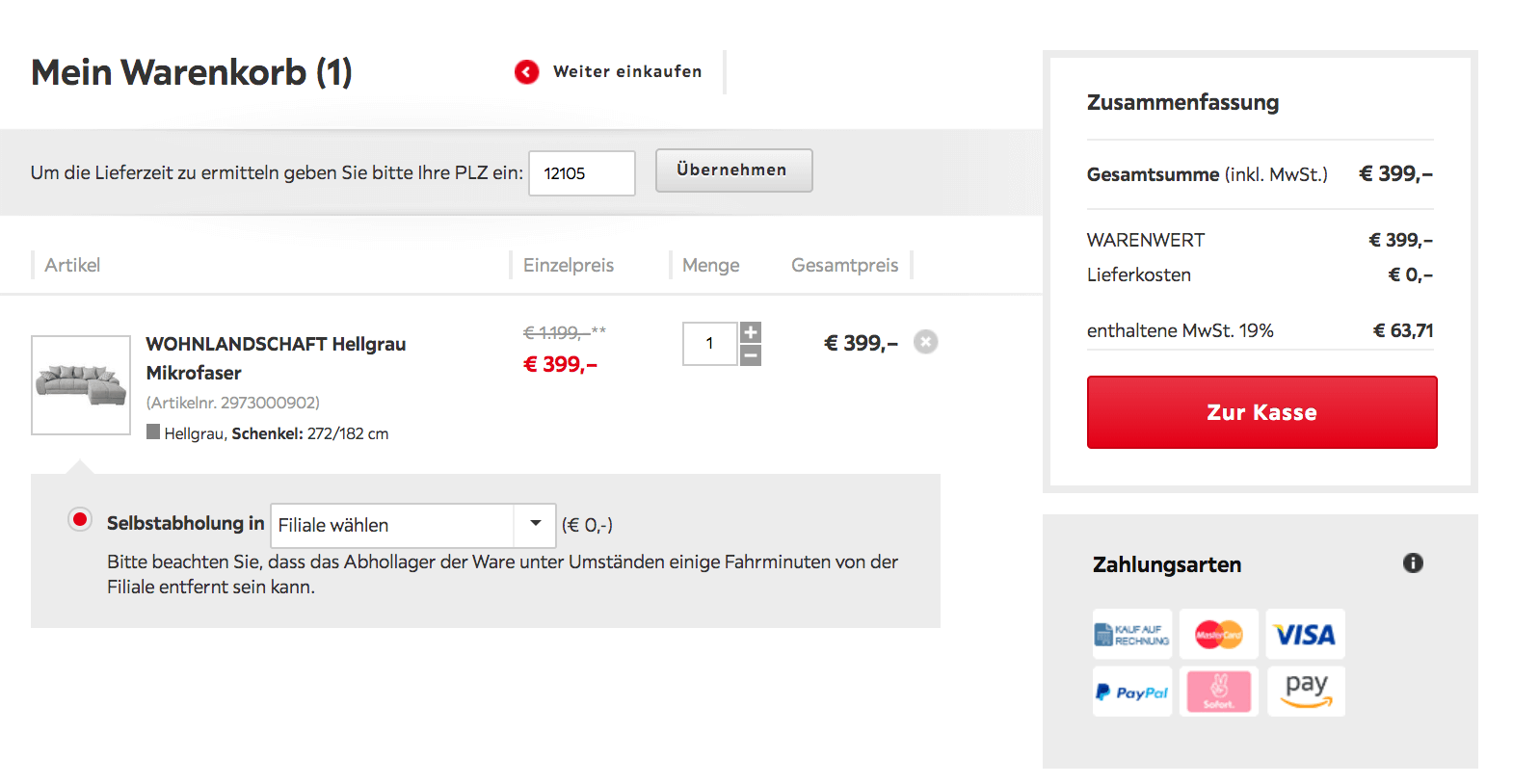
This is how an online furniture retailer uses defaults in the shopping cart
The common thread: Omnichannel is successful when users no longer even notice whether they are interacting online or offline. For companies, this means: Systems, data and processes must be integrated across channels.
For decision makers, it is not about individual tactics, but about a clear guideline on how omnichannel increases business success. The key points:
In this way, two separate channels become a single growth engine.
Whether click & collect, local ads or in-store experiences — the examples clearly show that the biggest lever for conversions lies not in isolated online or offline measures, but in their interaction. Decision-makers who implement omnichannel strategies not only increase sales in the short term, but also build trust and customer loyalty in the long term.
The challenge is not so much technical but strategic: Breaking down silos, managing budgets holistically and designing processes in such a way that customers no longer even notice when they are switching between channels. If this is successful, omnichannel will not be an additional task — but the basis for sustainable growth and higher profitability.

.png)


About one in four shoppers abandons their cart due to mandatory account creation. Here is how a guest checkout removes the barrier without losing customer accounts.

Most purchases are abandoned on smartphones. Discover where mobile checkouts fail and the levers you can use to boost your mobile conversion.

Around 7 out of 10 shopping carts are abandoned. Here are the known causes and the levers you can use to specifically lower your abandonment rate.

The cost of conversion optimization depends on a few key factors. Learn about pricing models, cost drivers, and why ROI is the more important figure.

Build SEO in-house or outsource to an agency? Five questions to help you make an honest make-or-buy decision.


.png)