€12.4 million in additional revenue through A/B testing!

Watch for free now
New Study: How AI Search is Changing SEO Visibility in E-Commerce
Read now


Link building is one of the most expensive levers in SEO — and also one of the most effective. But not every company benefits equally from this. The decisive factor is whether your market environment, keywords and basic optimization justify link building at all — or whether you should invest in other measures.
1. When link building is necessary — and when it burns your budget.
2. Which OnPage and user signals you need to fix first before links take effect.
3. How to use strategy and monitoring to ensure that links deliver real ROI
1. When link building is necessary — and when it burns your budget.
2. Which OnPage and user signals you need to fix first before links take effect.
3. How to use strategy and monitoring to ensure that links deliver real ROI
Backlinks are still among the most important ranking factors in SEO in 2025. But they are not a matter of course, but an investment that ties up budget, time and resources. That's why the key question is: When is link building really worthwhile for your business — and when is it more likely to be wasted energy?
The answer is differentiated. In some industries, links are the decisive lever for visibility, revenue and growth. In other areas, strong content, clear structures, and technical SEO are often enough to be successful. It is therefore not the general statement “You always need links” that is decisive, but a sober assessment of your competitive situation and your keyword set.
In large, highly competitive markets, link building is usually essential. These primarily include e-commerce segments such as consumer electronics or fashion, financial and insurance products, and healthcare and pharmaceutical offerings. This is not only about high margins and shopping carts, but also about massive competition in search results.
Typical markets where link building is almost always required:
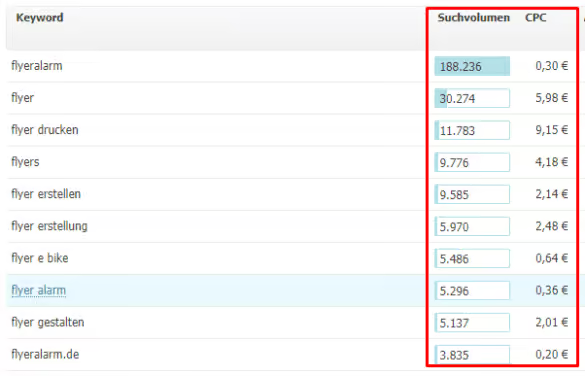
If you specialize in printing flyers, then almost certainly nothing will work without links.
The business impact here is immediate: Every place you win in the rankings means that you secure shares in a large market volume. In these cases, backlinks are not a luxury, but a prerequisite for sustainable visibility.
The situation is different if you're in a niche or operate a business model that is inherently less competitive. Many B2B companies can still be successful in 2025 with solid on-page optimization and high-quality content because their competitors in the digital sector often have some catching up to do.
Typical scenarios where link building is less important:
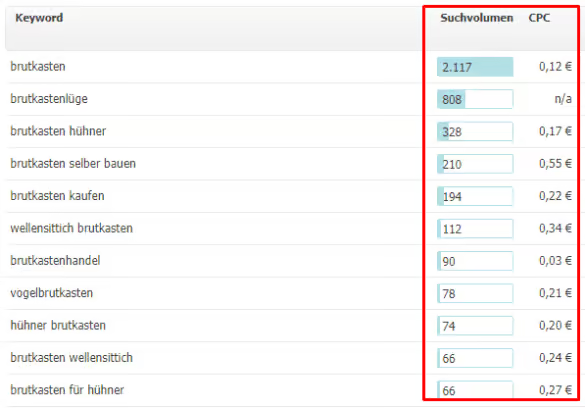
If you want to sell incubators for tawny owls, then the situation looks more relaxed - you will hardly need backlinks here.
The rule here is: Before you invest your budget in link building, check whether you can already achieve big effects with content, technology and user experience.
Even in markets where links matter, there is a simple rule: Backlinks only have an effect if the on-page basis is right.
Important on-page factors that must be clarified before link building:
Without these basics, every euro invested in backlinks fizzles out. Links reinforce existing strengths — they don't replace a clean base.
Link building is only worthwhile if it is embedded in a well-thought-out strategy. This means: First, goals and priorities must be clear. Which keywords should be strengthened, which pages have the biggest business impact, and where is it worthwhile to gain visibility?
Key issues for a sustainable strategy:
An effective strategy also focuses on quality over quantity. In 2025, a single link from a relevant, authoritative specialist portal is often worth more than dozens of inferior mentions.
Many companies invest in links without clearly maintaining the effect. That is a mistake, because only through consistent monitoring can you recognize whether the use is worthwhile. Rankings, organic traffic and conversion rates are the key figures.
How to ensure the ROI of your link building:
Many companies invest in links without clearly maintaining the effect. That is a mistake, because only through consistent monitoring can you see whether the effort is worthwhile. Rankings, organic traffic and conversion rates are the key figures.
Here's how to ensure the ROI of your link building:
Even though the effect of an individual link cannot always be proven in isolation, time series and comparisons provide a clear picture.
Backlinks are also a central ranking factor in 2025 — but not equally relevant for every company. In highly competitive markets, they are essential to ensure visibility and revenue shares. In niches or with clear long-tail strategies, on the other hand, you can often be successful even without large off-page investments.
What is important is: Link building is only worthwhile if the basis is right, if there is a clear strategy and if you consistently measure success. Then links are not just a cost factor, but a real growth lever for visibility, brand trust and revenue.

.png)

About one in four shoppers abandons their cart due to mandatory account creation. Here is how a guest checkout removes the barrier without losing customer accounts.

The cost of conversion optimization depends on a few key factors. Learn about pricing models, cost drivers, and why ROI is the more important figure.

Build SEO in-house or outsource to an agency? Five questions to help you make an honest make-or-buy decision.

Not every CRO agency tests systematically. These 7 criteria will help you identify reliable providers before you allocate your budget.

Around 73% of top online shops in Germany do not use an A/B testing tool. Here is why this is the biggest untapped lever in e-commerce and what systematic testing actually achieves.


.png)