€12.4 million in additional revenue through A/B testing!

Watch for free now
New Study: How AI Search is Changing SEO Visibility in E-Commerce
Read now


Dashboards are full of figures — but which of them really determine growth and profitability?
Many companies are still looking for visibility and traffic and overlook the key figures that really drive sales and ROI. In 2025, anyone who follows the wrong KPIs burns budget — whoever measures the right ones gains market share.
1. Why vanity metrics such as visibility or follower numbers are often misleading
2. How conversion rate, revenue, ROI and brand trust interact and make growth measurable
3. Which trends will shape KPI management in 2025
1. Why vanity metrics such as visibility or follower numbers are often misleading
2. How conversion rate, revenue, ROI and brand trust interact and make growth measurable
3. Which trends will shape KPI management in 2025
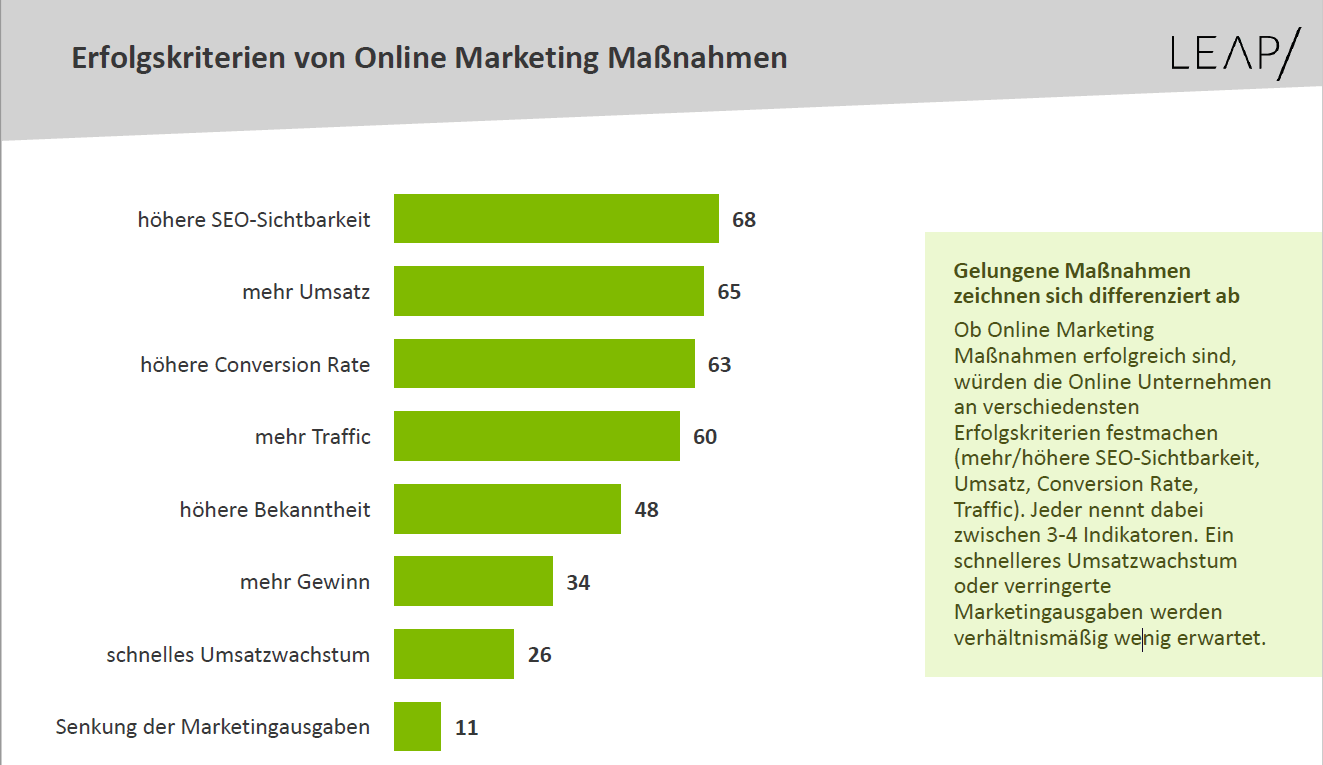
Online marketing provides endless data — but not every number moves your business forward. Many decision makers are impressed by increasing visibility or growing traffic. The problem: These key figures often say nothing about sales, profitability or market shares.
If KPIs are set incorrectly, this leads to expensive wrong decisions. Budgets are directed into measures that look good on the surface but have no effect in business. The result: burnt capital and missed growth opportunities.
Successful companies therefore manage marketing not with vanity metrics, but with key figures that directly contribute to sales, ROI and customer lifetime value.
Visibility sounds impressive — a rising graph in the SEO tool looks like a success. But visibility is only a win if it is achieved in the right markets and for the right keywords.
Example: Your company suddenly ranks for hundreds of irrelevant terms. The curve is pointing upwards, but neither the number of visitors nor the turnover are following suit. The result: a nice diagram, but zero business impact.
Decision-makers must therefore consistently qualify visibility:
Visibility must not become self-delusion. It is an early indicator — but it is only in combination with traffic, conversion and turnover that it becomes clear whether marketing investments are having an effect.
Our study makes it clear what customers really want
Many dashboards celebrate increasing visitor numbers like a victory. But what is the point if hundreds of thousands visit the site — and no one buys? For decision makers, it is clear: Traffic without relevance is a cost factor, not a success factor.
The key question is: Who is joining the site — and why?
Example: An e-commerce brand runs campaigns with lurid headlines. Clicks are up, but bounce rates are 90%. The result: a burnt budget and a weakened brand image.
What counts for decision makers is: Less but relevant traffic brings more revenue and lowers costs per acquisition.
Traffic is expensive — conversion determines ROI. Even a minimal increase in conversion rate can free up millions because it directly improves the performance of all marketing channels. It is therefore the central KPI in online marketing. It measures whether visitors actually become customers, leads, or subscribers.
Instead of just buying more visitors, companies must Optimize your conversion pipeline:
For decision makers, the conversion rate is the lever that determines profit or loss. It is not just a KPI, but the bridge between marketing investment and measurable business success.
At the end of every marketing discussion, there is the same question: Does it pay off? Visibility, traffic and even conversions are just means to an end — sales remain the decisive key figure. Only when marketing measures demonstrably contribute to increasing revenue have they fulfilled their purpose.
The return on investment (ROI) is closely linked to this. It shows whether the budgets used generate a positive contribution margin or whether money flows into measures that generate reach but do not create value. For decision makers, this is the hardest currency because it directly determines profitability and sustainability.
Particularly important: Increasing sales is not always the result of “more.” It is often a question of using existing resources more efficiently — less wastage, more focus on the channels and target groups that really create value. If you systematically track sales and ROI, you can position marketing investments as a business lever instead of as a cost block.
Not every effect of marketing is immediately reflected in figures. Brand recognition and trust are harder to measure, but they are still crucial for long-term success. Because without brand strength, conversions remain expensive and interchangeable — users switch to the competition more quickly if there is no trust.
Recognition ensures that a brand is selected by the customer in the first place (“First Choice”). Trust reduces perceived uncertainty and increases willingness to close deals — particularly when it comes to sensitive data, long-term contracts or high-priced products.
For decision makers, this means that branding is the basis on which all other KPIs are built. Visibility without trust creates clicks, but not customer loyalty. ROI without brand strength is short-term but not sustainable. Hard and soft factors must therefore be considered together: Sales are generated through efficiency — sustainable success through trust.
Figures convey security — but that is precisely the danger. Many decision makers fall into typical KPI traps that distort strategic decisions:
As a result, resources are invested in measures that look good but do not create any value. The solution lies in analyzing KPIs not individually but in combination and consistently aligning them with overarching corporate goals.
The requirements for KPI management are increasing. Users expect personalized experiences, the BFSG and data protection regulations such as the GDPR set tight frameworks, and technologies provide ever finer data. For decision makers, this means that KPI management is becoming more complex, but also more valuable.
The trends:
For 2025 and beyond, this means that successful companies do not see KPI management as pure controlling, but as a strategic management tool. Anyone who selects the right indicators, continuously reviews them and adapts them flexibly gives themselves a clear competitive advantage — because decisions can be made faster, more well-founded and more effectively.
Online marketing offers a wealth of data — but it is only the right key figures that turn it into a real control lever for your business. Visibility and traffic are useful as long as they are considered qualified. But it is only the conversion rate, turnover, ROI and brand trust that show whether marketing measures really create value.
The following applies to decision makers: Blend vanity metrics — manage business KPIs. Anyone who is guided by pretty curves in the SEO tool or increasing number of followers risks making wrong decisions. On the other hand, anyone who relies on clear, business-relevant KPIs gains transparency, efficiency and security.
In 2025, KPI management is more than reporting. It is strategic navigation:
The quintessence: KPIs are not an end in themselves, but the basis for profitable decisions. If you select it intelligently, connect it and regularly review it, you transform marketing from a cost block to an engine of growth.

.png)


About one in four shoppers abandons their cart due to mandatory account creation. Here is how a guest checkout removes the barrier without losing customer accounts.

The cost of conversion optimization depends on a few key factors. Learn about pricing models, cost drivers, and why ROI is the more important figure.

Build SEO in-house or outsource to an agency? Five questions to help you make an honest make-or-buy decision.

Not every CRO agency tests systematically. These 7 criteria will help you identify reliable providers before you allocate your budget.

Around 73% of top online shops in Germany do not use an A/B testing tool. Here is why this is the biggest untapped lever in e-commerce and what systematic testing actually achieves.


.png)