€12.4 million in additional revenue through A/B testing!

Watch for free now
New Study: How AI Search is Changing SEO Visibility in E-Commerce
Read now


Prices don't just determine margins — they control purchasing decisions. With the right psychological triggers, you make offers irresistible without making them cheaper. Anyone who uses pricing psychology correctly is not only able to generate more turnover in the short term, but can also strengthen trust in their own brand in the long term.
1. How you can use pricing psychology in a targeted manner to increase conversions
2. How emotional values influence willingness to pay
3. How to make even high-priced offers more attractive through clever presentation
1. How you can use pricing psychology in a targeted manner to increase conversions
2. How emotional values influence willingness to pay
3. How to make even high-priced offers more attractive through clever presentation
Prices are much more than simple figures. They are psychological triggers that can drive or block purchasing decisions. For you as a decision maker in digital business, this means that if you only calculate prices based on purely business logic, you are missing out on potential. Users don't buy rationally — they always evaluate prices in context, emotionally and in comparison to what sticks in their head as a reference.
Products have functional benefits — but it is the emotional value that makes them truly relevant to purchase. Buyers always subconsciously weigh up: Is the benefit experienced high enough to justify the “buying pain”?
Example: A hammer solves the problem of “hitting a nail in the wall.” But a Ferrari doesn't solve a “problem” — it creates status, belonging and emotion. It is precisely this emotional value that is massively increasing price acceptance.
Studies such as Prospect Theory (Kahneman/Tversky) show that people make buying decisions that seem objectively illogical — as long as the perceived profit outweighs the pain of spending. For you, this means that prices are not only defined through cost structures or market comparisons, but also through the emotional charge of your offer.
Practice criterion: Be aware of the emotional value your product creates. Status? safety? Saving time? Anchor this message visibly in pricing and communication. This not only increases the willingness of your visitors to buy, but also their trust in your brand.
A price is never perceived in isolation. Buyers always rate it in comparison — with competitors, with their own expectations, at usual threshold prices. This is exactly where pricing psychology comes in.
Threshold prices are a classic: A bike for 999€ looks acceptable; at 1,049€, many jump off. The difference is minimal in business terms — but enormous psychologically.
Equally important are Marker elements: Products or ingredients whose prices are particularly visible to customers (e.g. milk in supermarkets). If the price is right here, the entire shop is perceived as “fair.”
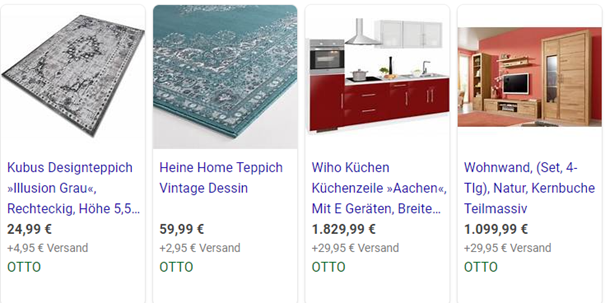
Large websites often use this effect: €0.99 is the norm here.
Practice criterion: Identify your brand elements. These can be central features or specific product categories. Make sure that these are attractively priced — they define the price perception of your entire offering.
Discounts are a double-edged sword. When used wisely, they increase the conversion rate. If they are miscommunicated, they diminish the value of your product.
The decisive lever is representation:
Practice criterion: Select the discount display so that it has maximum psychological impact — percentages for small sums, absolute figures for large savings. And avoid continuous sales that devalue your pricing structure.
Prices aren't just numbers — they're stories. How do you the price Framest, decides whether it is perceived as pain or as gain.
Example gym: An annual fee of 720€ is a deterrent. The same price, reduced to 60€ per month, is much easier to digest. If the whole thing is then combined with additional benefits (more locations, flexible opening hours), the higher price is even considered fair.

Monthly installments are much more painless than annual installments
Framing means embedding prices so that the customer sees the value — not just the number.
Practice criterion: Never just represent the price — but always the added value associated with it. This is how you shift the focus from “buying pain” to “feeling of profit” and has a positive effect on the number of your conversions.
People need reference points to classify prices. This is exactly where the anchor effect: The price seen first remains in mind and serves as a benchmark for all further offers.
You can actively control this:
Practice criterion: Consciously set price anchors. Users always compare — make sure they start with a high reference value. This increases the perceived value of your product or service. You'll also increase your average sales. Without anchors, customers gravitate towards the cheapest option. With Anker, the middle or even higher option is chosen more often. That lifts your average shopping cart value measurable at.
Not every product triggers emotions. Power or mobile phone contracts, for example, are classic low-involvement products. Customers here compare hard by price — every euro more feels like a loss.

The joy of comparing electricity prices is usually limited
This is where the dollar eyes effect comes in: Even the mere association with money (images of notes, percentage stamps, large “savings” notes) activates the “bargain system” in the brain.
Practice criteria
Insight: Business Impact
The dollar eyes effect ensures faster purchase decisions for price-sensitive products. This increases conversions in highly competitive markets — without you necessarily having to offer the lowest prices.
People are impatient — and weigh short-term gains more heavily than long-term benefits. That's exactly what that describes Hyperbolic discounting.
Example: Payment in installments or payment breaks (“Buy now, pay in 100 days”) postpone buying pain into the future. The customer experiences profit first (owning, using, enjoying the product) and only later the charge (payment).
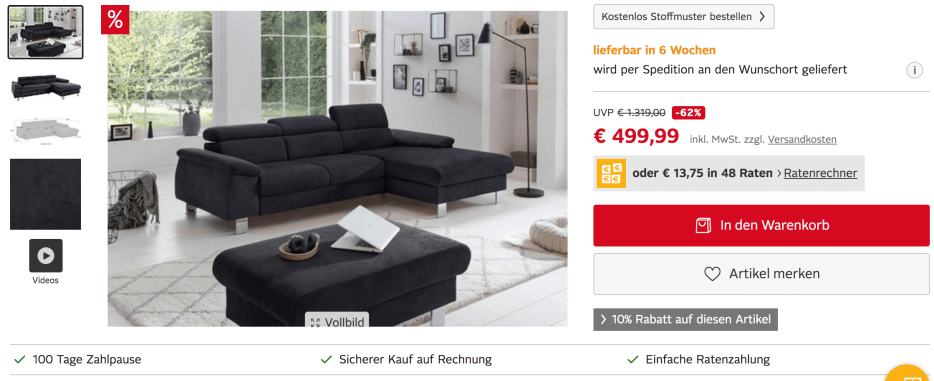
Discounts are always good
Practice criteria
Insight: Business Impact
Hyperbolic discounting leads to higher closing rates for high-priced products and reduces returns because customers already mentally record the product as “ownership.”
Artificial intelligence is currently changing the way prices are optimized. It makes pricing psychology scalable, individual and measurable in real time.
Pattern recognition: identify price sensitivity in real time
AI can recognize how price-sensitive a visitor is from user signals such as click behavior, shopping cart abandonments or scrolling depth. On this basis, dynamic decisions can be made: for example, whether a discount is displayed or not.
Personalized price presentation: Play discounts, installments and anchors individually
Not every customer reacts to the same triggers. While one immediately offers a -20% discount, the other appeals to an installment payment. AI makes it possible to display price anchors, discounts and payment models individually per user — in real time, data-driven and with maximum conversion probability.
Predictive pricing: How AI accelerates price experiments
Classic A/B testing at prices is risky and time-consuming. Based on historical data and behavioral patterns, AI can make forecasts as to which pricing strategy is highly likely to work. This massively accelerates the learning curve and minimizes revenue losses during the test phase.
Insight: Business Impact
With AI, you're taking pricing psychology to the next level:
Pricing isn't just a business process — it's psychology in numbers. Your users don't buy the price, but the story, the anchor and the perceived value behind it. Whether it's emotional benefits, clever context setting, anchor effects or AI-based personalization: Each of these levers can significantly increase your conversion rate — without you having to make your product cheaper.
Takeaway for decision makers:
When you use pricing psychology systematically, you increase your average shopping cart value, lower the price sensitivity of your customers and maximize the ROI of your marketing and sales efforts. Prices aren't just numbers — they're one of the strongest growth levers in your business.

.png)

About one in four shoppers abandons their cart due to mandatory account creation. Here is how a guest checkout removes the barrier without losing customer accounts.

Most purchases are abandoned on smartphones. Discover where mobile checkouts fail and the levers you can use to boost your mobile conversion.

Around 7 out of 10 shopping carts are abandoned. Here are the known causes and the levers you can use to specifically lower your abandonment rate.

The cost of conversion optimization depends on a few key factors. Learn about pricing models, cost drivers, and why ROI is the more important figure.

Build SEO in-house or outsource to an agency? Five questions to help you make an honest make-or-buy decision.


.png)