€12.4 million in additional revenue through A/B testing!

Watch for free now
New Study: How AI Search is Changing SEO Visibility in E-Commerce
Read now


1. Why user signals are crucial today
2. What are user signals — and how does Google interpret them?
3. The direct impact on your business
4th lever to improve user signals in a targeted manner
5. Practical implementation: What you can do immediately
6. Conclusion: User signals as a revenue lever
1. Why user signals are crucial today
2. What are user signals — and how does Google interpret them?
3. The direct impact on your business
4th lever to improve user signals in a targeted manner
5. Practical implementation: What you can do immediately
6. Conclusion: User signals as a revenue lever
SEO is often reduced to technology, content, and backlinks. But even the best technical basis, the most comprehensive content and a strong link profile don't automatically lead to rankings — let alone conversions. The decisive levers in between are User signals.
Google has long seen rankings as a dynamic process: Content that attracts clicks, engages users and provides added value rises to higher positions. Content that disappoints users continues to fall behind — regardless of how strong the classic factors are.
For you, that means:
Under User signals This is understood as measurable behaviors that allow conclusions to be drawn about a user's satisfaction with a search result. They are not an official ranking factor in the traditional sense, but a Relevance and quality indicator.
The most important user signals:
Google does not use this data in isolation, but in context. A search result that receives many clicks and keeps users is perceived as more relevant — and rewarded in the medium term.
Positive user signals have a double effect: on your visibility and on your conversion rate.
In short: User signals are the link between SEO visibility and business results. If you ignore them, you risk not only rankings, but also conversion potential.
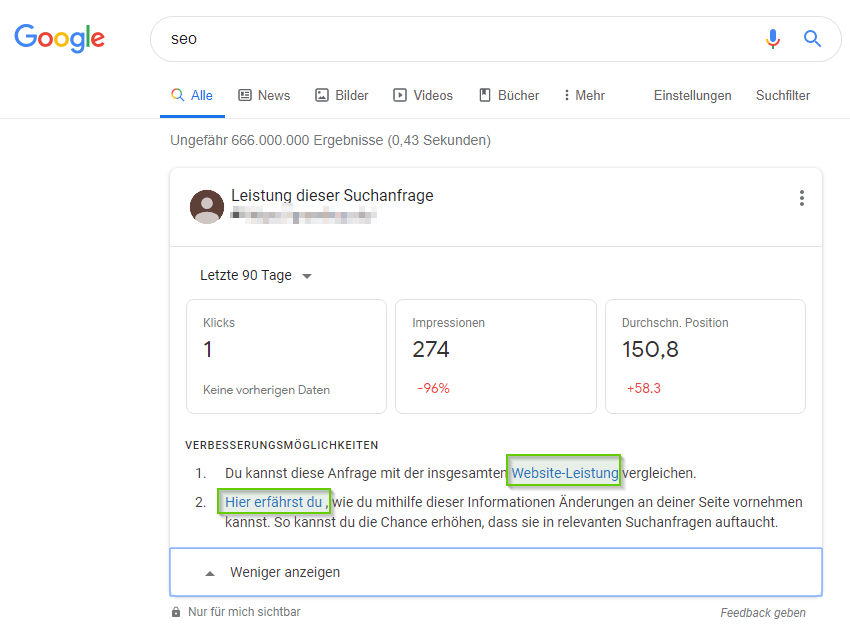
Goole screenshot
Artificial intelligence can significantly increase the impact of your SEO measures. More precise analyses of user behavior make it possible to identify patterns that would hardly be possible to identify manually.
Personalized content increases relevance for every single user. By tailoring content to individual needs, the length of stay is extended and the likelihood of interactions increases. In this way, positive user signals are specifically supported.
Predictive analytics also helps to identify potential incorrect decisions at an early stage. Trends and changes in the behavior of your target group can be predicted so that content strategies and optimizations can be proactively adjusted. The use of AI is therefore not only an efficiency lever, but also directly effective for higher rankings and better conversion rates.
Optimizing user signals is not an abstract theory — it starts with concrete measures that you can implement immediately. This is not about short-term tricks, but about comprehensible, systematic steps that promote visitor satisfaction and interaction.
Competitor analysis:
Take a look at which content ranks top in the SERPs for your target keywords. Analyze snippets, titles, meta descriptions, and content lengths. This allows you to see what information users expect and where content gaps exist. The structure of the content and the visual presentation also provide tips on how you can make your content more attractive.
Monitoring relevant KPIs:
Keep an eye on the most important metrics to see how users are interacting with your site and where there is a need for optimization. Analyze trends, deviations, and recurring patterns instead of looking at individual values in isolation. This allows you to quickly see which content or pages are working well, where users are jumping off or which areas particularly attract visitors' attention. Monitoring thus becomes the basis for targeted measures that sustainably improve both user satisfaction and conversion performance.
Continuous optimization instead of short-term tricks:
SEO and user signals are not a one-time task. Successful websites improve their performance step by step, based on data, user feedback and current trends. Continuous optimization ensures that content remains relevant, technical problems are resolved promptly and the user experience is constantly improved.
Key measures:
Continuous optimization therefore means: small, consistent steps instead of one-off major actions — this means that your measures are scalable in the long term and achieve maximum impact.
User-centered focus:
All optimizations should be based on the needs of your target group. Ask yourself the following questions continuously: What information is the user looking for? How quickly and easily can he find them? Which steps take him to the next goal (e.g. purchase, login, download)? Those who consistently focus on the user generate natural positive signals and measurable long-term business results. This is how user signals are systematically improved through a practical approach — which has a direct effect on rankings, visibility and sales.
User signals have long been more than just an SEO indicator — they are a direct lever for visibility, conversion and business success. Those who optimize them in a targeted manner not only ensure better rankings, but also increase users' willingness to buy and trust in their own brand.
Key findings at a glance:
Business impact:
Anyone who takes user signals seriously benefits from higher rankings, better conversions, and lower marketing costs. If you ignore them, you risk visibility, revenue, and customer satisfaction. In short, user signals are the direct link between the quality of your content, the behavior of your visitors and the measurable success of your company. Every optimization pays off — in the long term and sustainably.

.png)


Build SEO in-house or outsource to an agency? Five questions to help you make an honest make-or-buy decision.

AI search has arrived in German online retail: It used to be about whether an AI answer appeared for your search terms. Today, it is about whether your brand is cited as a source within it.
.jpg)
Traditional SEO methods are no longer sufficient for growth. Today, brand clarity, decision-relevant content, and active visibility determine whether SEO generates revenue.
.jpg)
AI Search evaluates not only content, but the comprehensibility of entire brands. Unclear positioning reduces the likelihood of being selected.
.jpg)
AI traffic is still low, but converts significantly better. Users are pre-qualified, making conversion even more important than traffic.


.png)
.jpg)