€12.4 million in additional revenue through A/B testing!

Watch for free now
New Study: How AI Search is Changing SEO Visibility in E-Commerce
Read now


Without visibility, no revenue. But short-term tricks and superficial optimizations are no longer enough. If you want to sell successfully today, you need an SEO strategy that has a lasting effect, delivers measurable results and is continuously improved.
1. Why the mobile user experience is critical to rankings and revenue
2. How to reduce bounce rates and increase conversions with fast performance.
3. What common pitfalls slow down shop visitors and how you ensure intuitive user guidance.
4. How unique and relevant content drives visibility, trust, and revenue
5. Why a clear link structure provides orientation for both Google and your users.
6. How artificial intelligence accelerates SEO measures and supports sustainable optimization.
1. Why the mobile user experience is critical to rankings and revenue
2. How to reduce bounce rates and increase conversions with fast performance.
3. What common pitfalls slow down shop visitors and how you ensure intuitive user guidance.
4. How unique and relevant content drives visibility, trust, and revenue
5. Why a clear link structure provides orientation for both Google and your users.
6. How artificial intelligence accelerates SEO measures and supports sustainable optimization.
Sustainable SEO optimization means permanently balancing search engine requirements and user needs. In this article, we'll show you six key levers that ensure the success of your online shop — from mobile first to PageSpeed and usability to content, internal linking and the use of AI.
Since mobile-first indexing, Google has primarily rated websites based on their mobile version. For online shops, this means that the mobile user experience determines visibility and sales. Over 60% of online purchases are now made via smartphones. If your mobile shop doesn't work smoothly, this leads to jumps — and thus to sales and ranking losses.
You should pay attention to this:
Here's how to optimize your performance:
A fast website not only improves rankings, but also lowers the bounce rate and increases sales.

Google Search Console: Does the Smartphone-Googlebot crawl the page?
SEO doesn't end when you click on the SERPs. Only when users quickly find their way around the shop and can shop without hurdles do positive signals and conversions arise. However, many shops are losing valuable potential here. This is often reflected in unclear navigation, which makes access to relevant categories difficult. Overloaded checkout processes with unnecessary intermediate steps also repeatedly lead to purchase cancellations. It becomes particularly critical when mobile optimization is neglected — for example due to filters that are difficult to find or controls that are too small, which make shopping on smartphones frustrating.
Best practices:
Good usability is a double lever: It improves customer satisfaction and has a direct positive effect on SEO visibility.
Google only understands content if it is clearly structured, unique, and focused on search intent. However, many online shops do not provide enough relevant content or use outdated standard texts.
Strategic recommendations:
High-quality content is a key driver of visibility, trust, and revenue.
Well-thought-out internal linking is much more than technical SEO fine-tuning. It determines whether Google and users find the really relevant pages in your shop. Many online shops are giving away potential here because they only link strongly from the homepage and leave deeper categories or high-margin products in the shadow.
The solution lies in a clear link architecture: From higher-level categories, users such as bots should be led directly to important sub-pages — without unnecessary click depths. Content areas such as guides or blog articles also offer the opportunity to establish thematic links and thus not only make the shop easier to crawl, but also more relevant in the context of search intent.
This has a double effect: Google recognizes the priority of your most important pages, while users intuitively find exactly the products or content they are looking for.
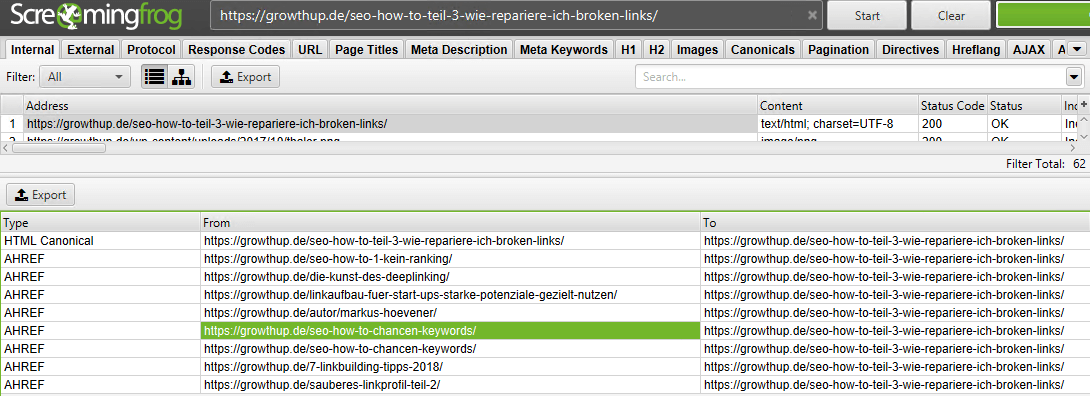
Internal linking using a GrowthUp contribution as an example
Artificial intelligence is fundamentally changing SEO — not only on the search engine side, but also when implemented in the shop. With every update, Google is getting better at understanding search intent and interpreting user signals. Classic tricks lose their effect, while holistic relevance and user experience become decisive.
For you as a shop owner, AI opens up new opportunities to efficiently meet these requirements:
The goal is not automation at any price, but the combination of AI efficiency and human strategy. When you find this balance, you not only optimize faster, but also more sustainably.
Sustainable SEO is not a quick shot, but a process that combines technology, content and user experience. If you just turn a screw, you'll achieve short-term effects — but only the interplay of mobile optimization, PageSpeed, usability, unique content, internal linking and modern AI approaches creates a foundation that really sustains.
For your online shop, this means:
Sustainable SEO optimization is therefore not just a marketing lever, but a clear business factor. It determines whether your shop will only keep up in the short term — or whether it will compete in the long term and grow profitably.

.png)


Build SEO in-house or outsource to an agency? Five questions to help you make an honest make-or-buy decision.

AI search has arrived in German online retail: It used to be about whether an AI answer appeared for your search terms. Today, it is about whether your brand is cited as a source within it.
.jpg)
Traditional SEO methods are no longer sufficient for growth. Today, brand clarity, decision-relevant content, and active visibility determine whether SEO generates revenue.
.jpg)
AI Search evaluates not only content, but the comprehensibility of entire brands. Unclear positioning reduces the likelihood of being selected.
.jpg)
AI traffic is still low, but converts significantly better. Users are pre-qualified, making conversion even more important than traffic.


.png)
.jpg)