€12.4 million in additional revenue through A/B testing!

Watch for free now
New Study: How AI Search is Changing SEO Visibility in E-Commerce
Read now


Good content is the basis for successful online marketing. But content alone isn't enough if you really want to achieve visibility and rankings with it. Only the interplay of keywords, structure, technology and user focus ensures that your content is found, clicked and read.
1. What types of keywords exist and how to prioritize them
2. How to create content that meets user intentions and ranks.
3. How a well-thought-out structure strengthens visibility and user guidance.
4. How titles, descriptions, and snippets drive clicks and conversions
5. How to prepare content for screen readers
6. What developments you should know to classify today's SEO strategies.
1. What types of keywords exist and how to prioritize them
2. How to create content that meets user intentions and ranks.
3. How a well-thought-out structure strengthens visibility and user guidance.
4. How titles, descriptions, and snippets drive clicks and conversions
5. How to prepare content for screen readers
6. What developments you should know to classify today's SEO strategies.
The basis for predictable ranking is to set the basics correctly. High-quality content only has its full effect when it is solid.
Keywords are the compass for Google and your users. Without a clear strategy, you risk your content getting lost in the crowd or attracting the wrong visitors. It is not only the search volume that is decisive, but above all the intent behind the request.
Short, highly competitive keywords such as “running shoes” are mostly used on home pages or categories. They generate a lot of traffic but require high competition. Longer keywords, so-called longtails such as “running shoes for women size 38”, have a lower search volume, but lead directly to relevant sub-pages and increase the conversion probability.
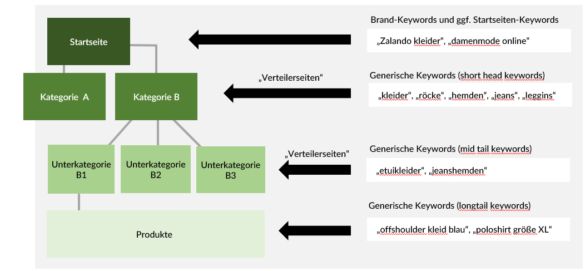
Is a keyword more likely to lead to the homepage or to the subpage
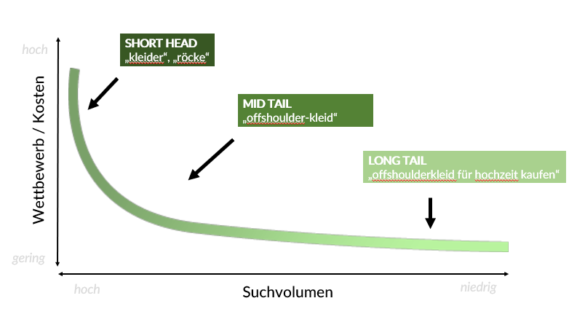
The higher the search volume, the higher the competition
In addition to length and competition, classification according to search intent is decisive:

The search results for a navigational keyword


AI can help you efficiently analyze keywords, form clusters, and uncover gaps. In this way, you prioritize terms according to business impact and competition and ensure that your SEO measures are predictable and measurable.
Content is the lever that converts visitors into conversions. Google not only evaluates keywords, but above all how well content fulfills user intent. This means: Your content must provide answers, solve problems and be clearly structured and easy to consume.
For a successful implementation, you should pay attention to the following points:
AI can further accelerate and improve content processes: It identifies gaps in existing content, provides suggestions for headlines or meta descriptions, and can predict engagement potential. The key is to combine AI efficiency with human expertise — this is the only way to create content that really ranks and converts.
Internal linking is more than fine-tuning SEO: It controls how Google and visitors perceive your website. Pages that receive many links are rated as more important by search engines, while visitors are thus intuitively guided to relevant content.
It is important that the architecture is logical and user-friendly:
AI can also provide added value here: It shows which pages are underserved, where link potential exists and which pages should be prioritized — for example, those with high traffic potential or high-conversion landing pages. In this way, you use internal links not only for SEO optimization, but also as a targeted lever for more sales.
Title, description, and structured data are often the first point of contact between potential customers and your website. An unattractive snippet can prevent clicks, even if your content is perfect.
Pay attention:

A negative example

A positive example

An even better example with structured data
AI can help here by providing suggestions for optimized snippets or automatically analyzing A/B tests for meta data. This will improve CTR and drive more qualified traffic to your site.
Users read differently on screens than on paper. Longer paragraphs, complicated sentence structures, or confusing content lead to jumps.
Best practices:
Anyone who is proficient in web-friendly copywriting ensures that users not only consume the content, but also carry out the desired action — be it purchase, login or download.
SEO has changed a lot over the last ten years. In the past, three factors dominated: content, links and technology. User experience, mobile optimization, structured data management and AI-based analysis are now central elements.
Today's ranking formula is: relevance + user satisfaction + technical implementation + internal structure. Mastering these factors creates a solid foundation for predictable, sustainable growth.
Ranking really well with content requires a solid foundation: keyword strategy, high-quality content, internal links, meta data, web-friendly copywriting and taking current ranking factors into account.
Takeaway:

.png)


Build SEO in-house or outsource to an agency? Five questions to help you make an honest make-or-buy decision.

AI search has arrived in German online retail: It used to be about whether an AI answer appeared for your search terms. Today, it is about whether your brand is cited as a source within it.
.jpg)
Traditional SEO methods are no longer sufficient for growth. Today, brand clarity, decision-relevant content, and active visibility determine whether SEO generates revenue.
.jpg)
AI Search evaluates not only content, but the comprehensibility of entire brands. Unclear positioning reduces the likelihood of being selected.
.jpg)
AI traffic is still low, but converts significantly better. Users are pre-qualified, making conversion even more important than traffic.


.png)
.jpg)