€12.4 million in additional revenue through A/B testing!

Watch for free now
New Study: How AI Search is Changing SEO Visibility in E-Commerce
Read now


Many online shops waste valuable potential through content that is only written for search engines. If you ignore user intent, you lose traffic, conversion, and revenue. This article shows how to create content strategically for people and thus achieve measurable economic benefits.
1. Why classic SEO content often only serves Google and does not convince visitors.
2. How user intentions and KPIs are integrated into content strategies to increase traffic and conversion
3. How AI optimizes content creation and measurably increases economic benefits.
1. Why classic SEO content often only serves Google and does not convince visitors.
2. How user intentions and KPIs are integrated into content strategies to increase traffic and conversion
3. How AI optimizes content creation and measurably increases economic benefits.
Many online shops invest enormous resources in product development, research and marketing — only to then save on content. The result is texts that, although formally contain keywords, do not really convince anyone. You could say: The product is a Ferrari, the content is an old bicycle trailer.
Classic “SEO content” often only fulfills one function: to feed search engines. The users who are ultimately supposed to buy are barely picked up. You keep scrolling, jumping off, or clicking on a competitor. The consequence? Lower conversion rates, poorer user signals, and ultimately less revenue.
So the key question is: How can content work for both Google and real people — and in doing so bring measurable economic benefits? The answer lies in user-centered content that recognizes and serves visitors' intentions and actively supports the buying process.
The term “SEO content” has been around for years. It suggests that you achieve top rankings simply by using term frequency, keywords in headlines and title tags. But that is a fallacy. Although such content is recognized by search engines, its effect on users is often ineffective.
In practice, this means that texts that are only written for Google do not meet any real information or decision-making needs. Users jump off, length of stay decreases, bounce rates increase — and Google registers exactly these signals. If you only deliver semantics, you miss the crucial point: Content must advise, inform and create trust.
The decisive mistake of many online shops is that they lose sight of people. Products are presented perfectly, content remains generic, impersonal or simply unusable. As a result, ranking potential is wasted and every SEO measure becomes inefficient.
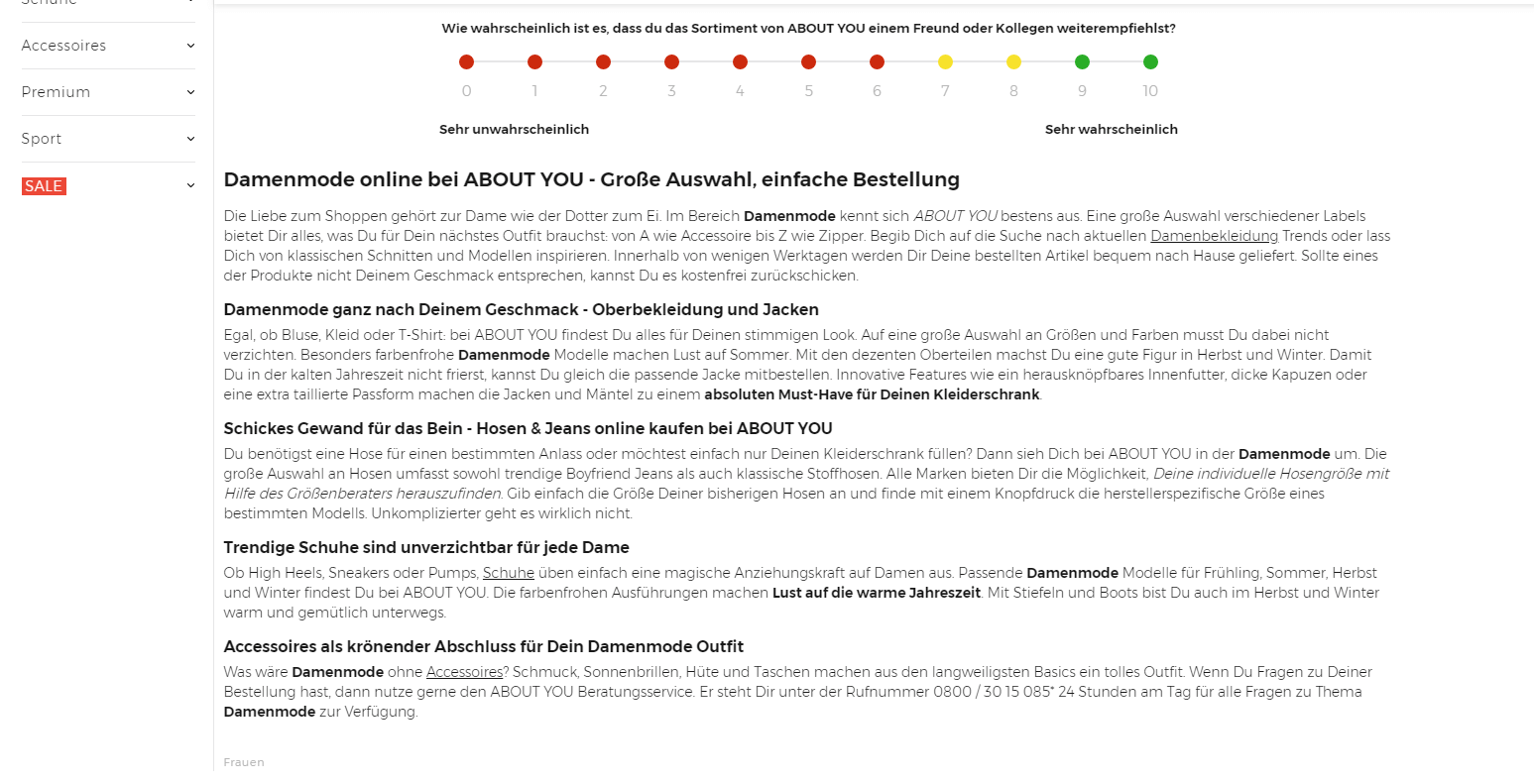
How likely is it that someone will buy from ABOUT YOU after reading this text?
Google has long understood that user interaction is a key to high-quality content. In addition to classic SEO factors such as keywords, loading speed, and backlinks, Google observes KPIs such as:
These signals flow directly into the evaluation of your content. Even perfectly optimized keywords are of little use if users do not see any added value. Good content must therefore be semantically correct and meet user expectations — this is the only way to reward it in the rankings in the long term.
The clear consequence: If you write content just for the machine, you risk jumping off visitors, falling rankings and missed sales opportunities. On the other hand, anyone who focuses on the user transforms SEO into a real economic lever.
Good content starts with understanding visitors' intent. A user who is looking for “snowboards” does not want just any product, but information, orientation and a clear purchase decision. A pure SEO text usually only covers a fraction of this requirement.
Online shops should design content in such a way that it covers various user paths:
If you strategically tailor content to these intentions, you not only increase retention time, but also conversion rates. Each text thus becomes an active tool that steers users, builds trust and at the same time improves the ranking.
Content shouldn't just look good or contain keywords—it must promote sales. Effective content informs, motivates and answers the questions that potential customers have before making a purchase decision.
Examples from practice show:
The combination of relevant information, a clear structure and targeted call-to-actions transforms visitors into buyers. Content thus becomes a measurable economic lever — every piece of text directly contributes to sales.
Artificial intelligence can significantly improve content creation and optimization. With AI, large quantities of search queries can be analyzed, content can be tailored to user intentions and optimize existing texts based on data.
Practical areas of application:
By using AI, content is not only created more efficiently, but also measurably more effective: rankings improve, users stay on the site longer, and economic benefits increase. AI therefore helps to turn mediocre SEO content into strategically effective content.
Classic SEO content is no longer enough to increase rankings, traffic and sales. Effective content is based on user intent, answers questions, provides orientation and guides visitors to a specific purchase decision.
The combination of well-structured category pages, detailed product pages and advisory guides creates trust, binds users longer and improves user signals for Google.
With AI-based analysis and optimization, this content can be created efficiently and continuously improved. In this way, you turn every text into a strategic lever that convinces both search engines and real customers — and delivers measurable economic success.

.png)


About one in four shoppers abandons their cart due to mandatory account creation. Here is how a guest checkout removes the barrier without losing customer accounts.

Most purchases are abandoned on smartphones. Discover where mobile checkouts fail and the levers you can use to boost your mobile conversion.

Around 7 out of 10 shopping carts are abandoned. Here are the known causes and the levers you can use to specifically lower your abandonment rate.

The cost of conversion optimization depends on a few key factors. Learn about pricing models, cost drivers, and why ROI is the more important figure.

Not every CRO agency tests systematically. These 7 criteria will help you identify reliable providers before you allocate your budget.


.png)