€12.4 million in additional revenue through A/B testing!

Watch for free now
New Study: How AI Search is Changing SEO Visibility in E-Commerce
Read now


Checkout is the most critical moment of every customer journey. This is where it is decided whether a prospective customer becomes a customer — or whether the turnover is lost in the last step. The figures are alarming: between 60 and 90% of all online purchases are canceled. For companies, this means that huge sales potential remains unused, marketing investments go nowhere, customer lifetime values fizzle out.
1. Where most abortions occur — and why.
2. How different types of users react to the checkout
3. Which 7 specific adjustments will help you drastically reduce abortions.
1. Where most abortions occur — and why.
2. How different types of users react to the checkout
3. Which 7 specific adjustments will help you drastically reduce abortions.
The good news is that you can specifically reduce abandonment. By understanding why users drop off and systematically removing barriers, you not only increase conversions but also lower your cost per acquisition. This article shows you how to optimize your checkout processes with seven practical measures—turning potential cart abandonments into measurable growth.
Not all abandonment is equally costly. Many users add products to their cart without having a firm intention to buy—these are the so-called window shoppers. They browse, compare, and save items for later. Abandonment at this stage is annoying, but rarely a direct loss of revenue.
The situation is quite different at checkout. Here, users have already shown purchase intent, selected products, and started the payment process. Every abandonment at this stage means lost revenue, wasted marketing budget, and, in the worst case, a permanently lost customer.
The economic impact is enormous: studies show that even small improvements in the checkout process can achieve double-digit conversion uplifts. Therefore, focus primarily on the checkout itself—this is where you will see the highest ROI.
To reduce abandonment, you need to understand the needs of different user types. Window shoppers and ready-to-buy customers react differently and require different solutions.
From a business perspective, this means that by segmenting and specifically optimizing for both groups, you reduce abandonment, increase your conversion rate, and boost customer lifetime value. Your focus should be on ready-to-buy users, as they hold the highest revenue potential for you. However, you shouldn't underestimate the role of window shoppers, who may return to your site later as potential ready-to-buy customers.
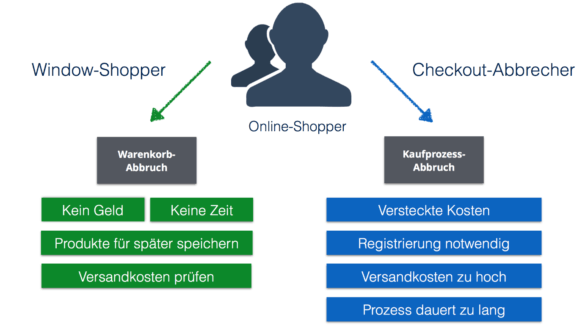
Checkout optimization: Cart vs. checkout abandonment
The checkout is no place for hidden costs. Studies show: 41% of users abandon their purchase because unexpected fees appear in the final step —whether for shipping, packaging, or payment surcharges. What starts as a bargain turns into a disappointment, leading directly to a bounce.
The solution: radical cost transparency.
Business impact: Transparency builds trust. Users stay in the checkout instead of checking competitor prices. Every prevented abandonment acts as a conversion multiplier—a direct lever for increasing revenue without increasing traffic costs.
How do you actually know which of these points really resonates with your customers? Most shops don't. In our analysis of 2,496 of the highest-grossing German online shops, 76 percent do not use an A/B testing tool. Checkout optimizations there are based on experience and assumptions, not measurement. This is particularly costly here of all places, because the checkout is the point with the highest purchase intent. If you optimize incorrectly at this stage, you lose customers who were already ready to buy.
Read more in our AI & SEO Study for German E-Commerce.
Almost a third of all users (29%) abandon their purchase if registration is mandatory. The reason: psychological barriers. Many have had bad experiences with spam or unclear data usage. New customers, in particular, want to buy first—without a membership, without a password, and without joining a "community."
The solution: Guest checkout as the default option.
Business impact: A guest checkout allows you to reach occasional shopperswho would otherwise abandon their purchase. At the same time, you create incentives for voluntary registration by highlighting clear benefits. This maximizes conversions in the short term and customer loyalty in the long term.
Users have clear expectations when it comes to payment methods—and they are rarely willing to compromise. Studies show: one in five checkout abandonments occurs because the preferred payment method is missing. PayPal, credit card, direct debit, invoice: what sounds like extra effort to you is often the deciding factor for the user.
The same applies to shipping: 11% of users abandon their cart because their preferred shipping method is not offered. For some, a parcel locker is essential, while others only trust their preferred logistics provider.
The solution: freedom of choice instead of restrictions.
Business impact: Every missing payment or shipping option means lost revenue. By offering a wide selection, you not only increase your conversion rate but also build trust—especially with first-time buyers who are not yet familiar with your brand.
A checkout form isn't a bureaucratic hurdle—it's the final step toward a sale. Every unnecessary field is a conversion killer. Users want to buy quickly and without friction. Long forms, complicated questions, or unclear input fields lead to cart abandonment.
Here is how to do it better:
The result: less frustration, fewer abandonments, more trust.
Studies show that optimized forms can increase conversion rates by up to 22%.
Business impact: A streamlined form reduces friction and speeds up the purchase. Every abandoned entry costs revenue—every simplified field means real money.
A checkout is not an adventure, but a clear path. Users want to know: How many steps are left? Where am I right now? Can I go back if I make a mistake?
Therefore: make the process transparent.
Tip: Test whether your target audience prefers a one-page checkout or several short steps. For some markets, a compressed flow works best, while others prefer several small stages. A/B testing will provide the answers here.
Business Impact: Clear guidance reduces uncertainty, builds trust, and lowers abandonment rates. Every extra click costs revenue—every transparent structure guides customers safely to their goal.
Even with a full shopping cart, customers will abandon their purchase without trust. The psychological hurdle is particularly high during checkout, involving sensitive data, payment details, and personal information. Any doubt raised here means a lost sale.
How to build trust during checkout:
Business Impact: Trust equals revenue. Every doubt leads to abandonment, while every trust-building element increases the likelihood of the customer completing the final click. A secure checkout is not just a basic requirement; it is a conversion driver.
The checkout is not just a minor detail; it is the conversion hotspot of your shop. It is the point between the shopping cart and the final purchase where it is decided whether your marketing investments turn into revenue or go to waste.
A successful checkout means transparency, simplicity, and trust. From clear cost communication and flexible payment options to streamlined forms—every barrier you remove directly impacts your conversion rate and reduces abandonment.
The business impact is measurable:
Takeaway: Don't view the checkout as just the final step, but as a critical performance lever. Consistent optimization here not only boosts short-term revenue but also builds long-term trust and loyalty.

.png)

About one in four shoppers abandons their cart due to mandatory account creation. Here is how a guest checkout removes the barrier without losing customer accounts.

Most purchases are abandoned on smartphones. Discover where mobile checkouts fail and the levers you can use to boost your mobile conversion.

Around 7 out of 10 shopping carts are abandoned. Here are the known causes and the levers you can use to specifically lower your abandonment rate.

The cost of conversion optimization depends on a few key factors. Learn about pricing models, cost drivers, and why ROI is the more important figure.

Not every CRO agency tests systematically. These 7 criteria will help you identify reliable providers before you allocate your budget.


.png)