€12.4 million in additional revenue through A/B testing!

Watch for free now
New Study: How AI Search is Changing SEO Visibility in E-Commerce
Read now


Pickawood sells high-quality, custom-made furniture online. Their target audience is on average in their mid-50s and not particularly tech-savvy. With LEAP, Pickawood established a structured CRO process: a simpler configurator, increased trust, and a hypothesis-driven system instead of relying on gut feeling.
◉
Free & no obligation
◉
Response within 24 hours
◉
CRO expert instead of sales

despite rising cost-per-click
across the entire domain
before purchase
A target audience with little digital affinity was expected to spend a lot of money online on a piece of furniture they had never seen in person.
Pickawood’s target audience is on average in their mid-50s, often homeowners, but without digital-native experience. The sales cycle is around 50 days because a purchase of this magnitude is usually evaluated extensively. This made classic conversion optimization difficult: focusing tests directly on the final purchase took too long to yield actionable insights.
Before our collaboration, there was also no underlying concept. There were isolated A/B tests, but no strategy for prioritizing topics. Many previous optimizations missed the mark—features were built that made sense from a company perspective but were never actually used by the customer.
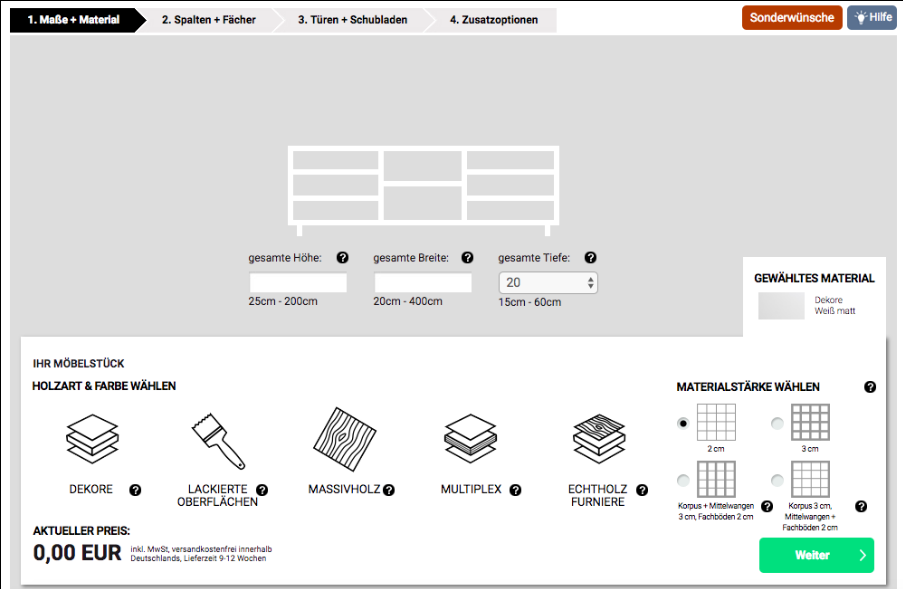
The configurator before optimization
Sensory overload, lack of intuition, and poor audience alignment: confusing wording, small font sizes, and tiny buttons made it difficult for Pickawood’s older target audience to find their way around.
From gut feeling to a hypothesis-driven CRO process
Tim Ehling, founder and CEO of Pickawood, talks with LEAP founder Thomas Gruhle about optimizing a complex sales funnel for a skeptical target audience and how structured testing reduced the cost per conversion by 30 percent.

Also available to listen on Spotify.
Listen on the go via Spotify or add it to your Spotify playlist for later.
Listen on Spotify now
Instead of an audit filled with a hundred unused suggestions, we focused on the combination of impact and effort from the very beginning.
LEAP established an end-to-end process based on user research, hypothesis generation, and prioritized testing. Remote user testing revealed how customers were actually using the configurator, providing a foundation for prioritized testing rather than relying on gut feeling.
Because a shop relaunch was happening in parallel, these insights were integrated directly into the new design—tightly coupled rather than an afterthought.
Four stages that turned individual A/B tests into a permanent CRO process.
A one-off project turned into a permanent way of working.
The bounce rate across the entire domain dropped by around 20 percent, while micro-conversions such as configurator starts or quote requests increased by 25 to 30 percent. The cost per conversion fell by around 30 percent, even though Google click prices rose significantly during the same period.

"LEAP is definitely the most dedicated and professional agency we have worked with in the field of SEO and CRO."
Tim Ehling · Founder & CEO, Pickawood
Free download
~10 years without targeted SEO work
Break-even after 6 months
9 months to ~2× visibility


See which of these levers are realistic for a shop like yours – in a brief conversation with the team that handled the Pickawood case. Not a generic PDF audit, but concrete levers for your funnel.



Around 73% of top online shops in Germany do not use an A/B testing tool. Here is why this is the biggest untapped lever in e-commerce and what systematic testing can actually achieve.
Read article

Conversion rate benchmarks for German e-commerce in 2026, broken down by industry. How to interpret CRs and achieve predictable, successful growth.
Read article
A website relaunch often resets your conversion knowledge to zero. Here is how to integrate your test results into the new design concept.
Read article